
If we’re going to be literal, the “dog days of summer” refers only to the insufferably hot and humid period between July 3 and August 11. This time coincides with the rising of Sirius, the Dog Star, which is part of the constellation Canis Majoris—the “Greater Dog.”
According to the Old Farmer’s Almanac, “In ancient Greece, Egypt, and Rome, it was believed that Sirius’s dawn rising in mid- to late summer contributed to the extreme weather of the season. In other words, the ‘combined heat’ of super-bright Sirius and our Sun was thought to be the cause of summer’s sweltering temperatures. The name ‘Sirius’ even stems from the Ancient Greek seírios, meaning ‘scorching.’”
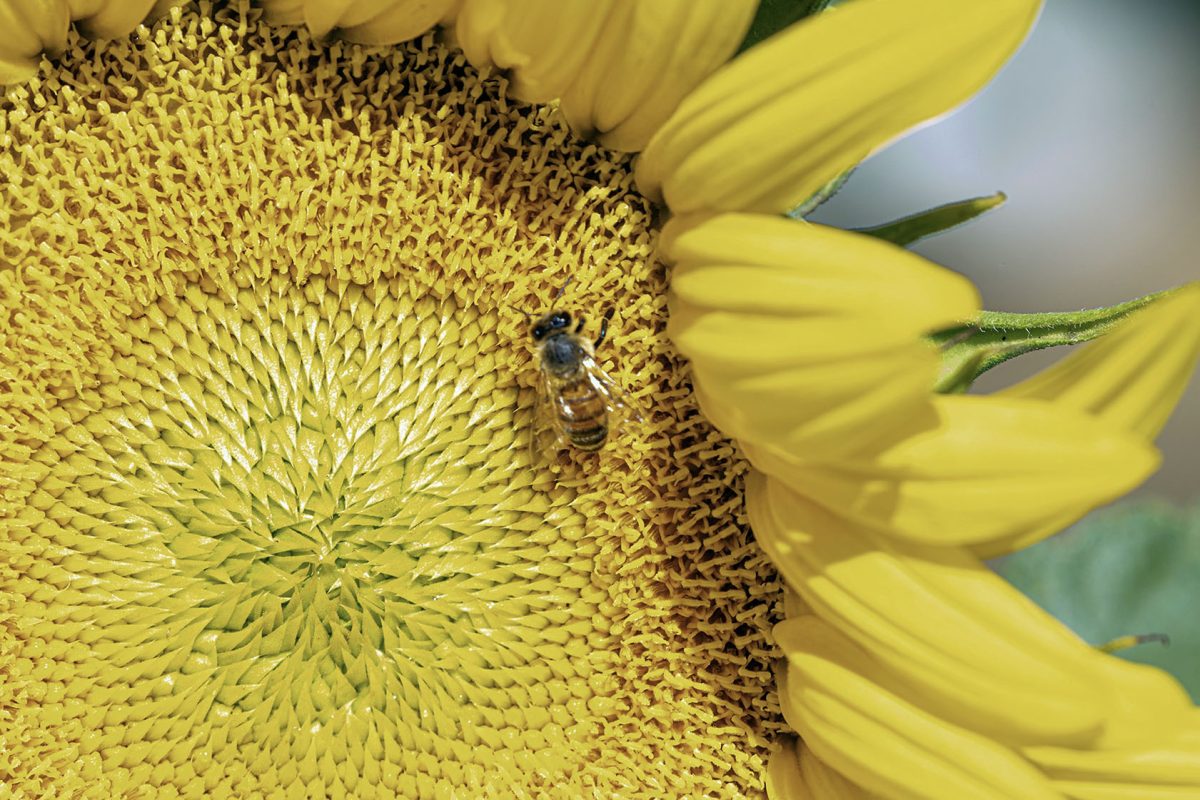 But we’re not going to be literal. Here in Central Texas, the “dog days of summer” spill over into late August and, in more recent decades, through September. Only when we get to October does our average high temperature dip below 90 degrees. Add a humidity of 90+ per cent—and yes, Central Texas is getting more humid, because our warmer atmosphere holds more water—and you get, well, what I think of as “dog days.”
Just as we humans do, the landscape reflects this stress. June and the first part of July may have been nice and green here in Hays County, but unless they’re being watered, our gardens and natural areas are beginning to turn brown. The exception? Sunflowers.
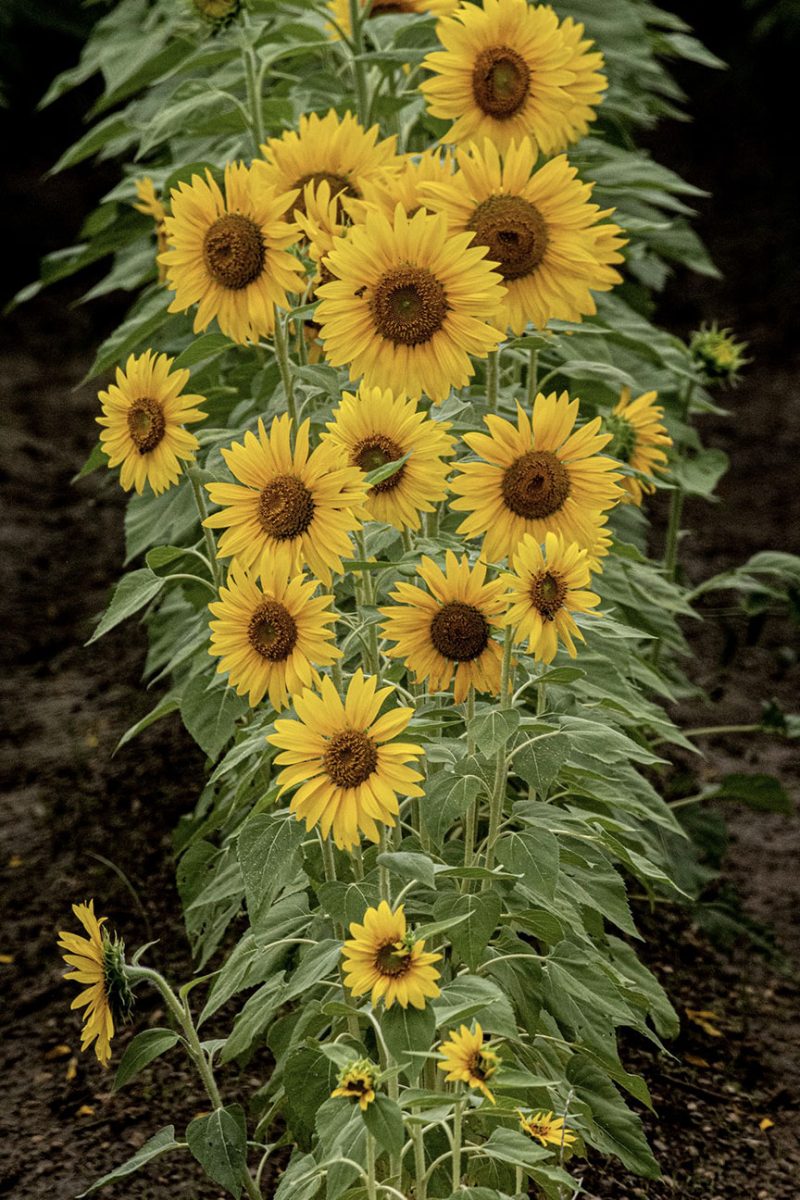
Of all the sunflowers, the common sunflower (Helianthus annuus L.) is both the most ubiquitous and the easiest to grow. Indeed, if you feed birds, it’s almost guaranteed that you’ll have this annual sunflower growing somewhere on your property. Reaching 1.5 to 10 feet in height, this sunflower isn’t picky; just give it well-draining soil and lots of sun, and it’ll be happy.
Does the sunflower actually follow the sun? Yes and no. Young sunflowers do possess heliotropism, which allows them to track the sun during the day, and swivel back to the east during the night. In a fascinating video, the Australian Academy of Science explains how this process works.
It’s the sunflower’s circadian rhythm—and yes, plants, like humans, do have one—that cues this movement to begin. Besides encouraging growth, facing the sun results in greater pollen production and more vivid color, both of which make the flowers more visible and attractive to pollinators. The result is striking. The Australian Academy of Science has found that east-facing sunflowers attract five times as many pollinators as those facing west.
Cultivated since pre-Columbian times, the common sunflower has been used to produce dyes, flour, and oils both for use on hair and in cooking. Oil is still one of the primary uses of sunflowers, though those you see cultivated for this purpose are likely a hybrid variety.
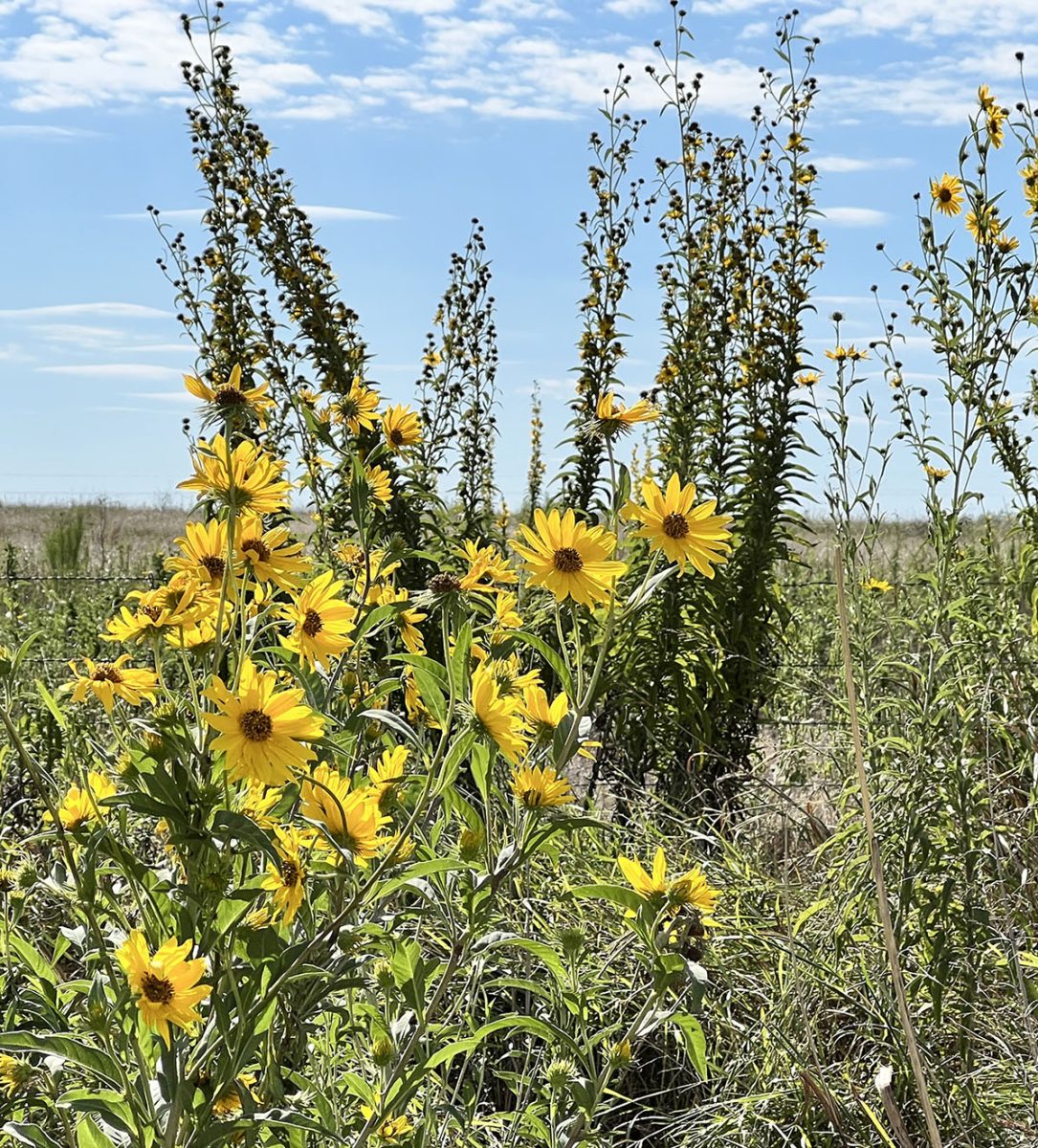
While the common sunflower tends to bloom from early summer into August, its cousin the Maximillian sunflower (Helianthus maximiliani Schrad) flowers from late summer through October. A perennial, this plant favors moist clay soil but can grow in a wide variety of conditions; for this reason, I see it most often in or near drainage ditches. That said, I also have some growing in my own yard. I’ve seldom if ever seen Maximillian sunflowers for sale in nurseries, but it is available from Native American Seed Company, which is where I ordered mine.
What makes Maximillian sunflowers so spectacular is not just their height, which can reach 10 feet, but also the arrangement of blossoms up and down the stalks. This very desirable plant is a heavy producer of both seeds and nectar, making it highly attractive to pollinators, birds, and other wildlife. One negative: Because Maximillian sunflowers are tasty to livestock, they’re also not deer resistant. This fact, along with their height and tendency to fall over if not supported, is a good reason to plant these sunflowers in the back of a garden, if you’re planting them at home.
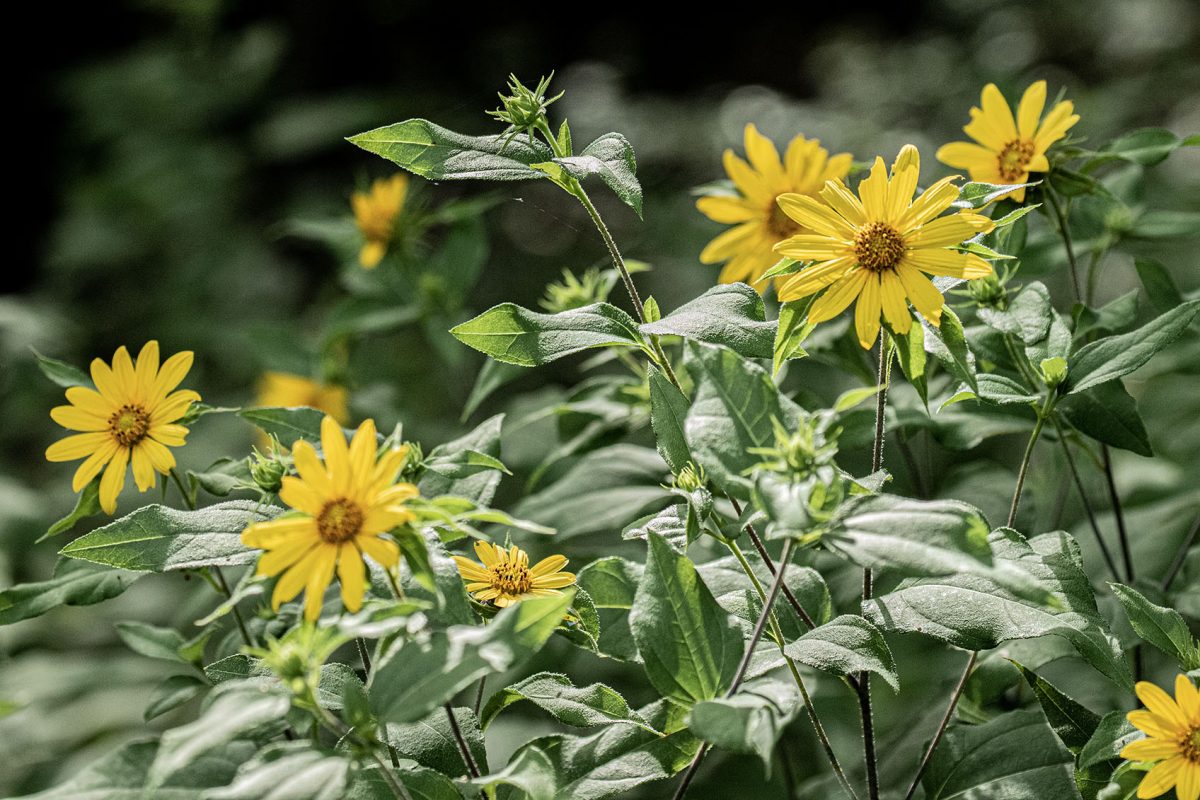
Another perennial sunflower you won’t find at most native plant nurseries is the hairy or rough/rough-leaf sunflower (Helianthus hirsutus Raf.). True to its name, this plant features leaves the texture of sandpaper. Though it can reach a height of 6 feet, this fall bloomer more typically grows to about 3. The rough sunflower tends to form dense colonies, spreading by both seeds and underground rhizomes. It can be aggressive, but it is also easily pulled up.
Of all the sunflowers I know, the rough sunflower may be the toughest. Though it appreciates a good rain, this plant can thrive in dry, rocky soil. In fact, that’s where I initially found it, growing beside a gravel parking lot at the Narrows of the Blanco River. All the rough sunflower I now have in my garden came from a single small plant I ripped from the rocks there almost 30 years ago.
Though in a different genus, sunflower goldeneye or plateau goldeneye (Viguiera dentata (Cav.) Spreng.) is my favorite in the sunflower family (Asteraceae). Another perennial, this plant can handle either sun or shade, though it tends to grow taller—up to 6 feet—in the shade. This plant tends to be bushy, almost wooden at its base, so it requires more room than some of its relatives.
What I love about this plant is its almost iridescence when in full bloom. The small daisy-like blossoms appear to glow, and when a whole row of these plants is flowering, the effect is stunning. My own collection of sunflower goldeneye, which spans the length of our property along the street, can be traced to a handful of seeds—or perhaps a single plant; I can’t recall—that I collected on the side of Hunter Road decades ago. Since that time, the population has proliferated to the homes of neighbors both beside and across from us.
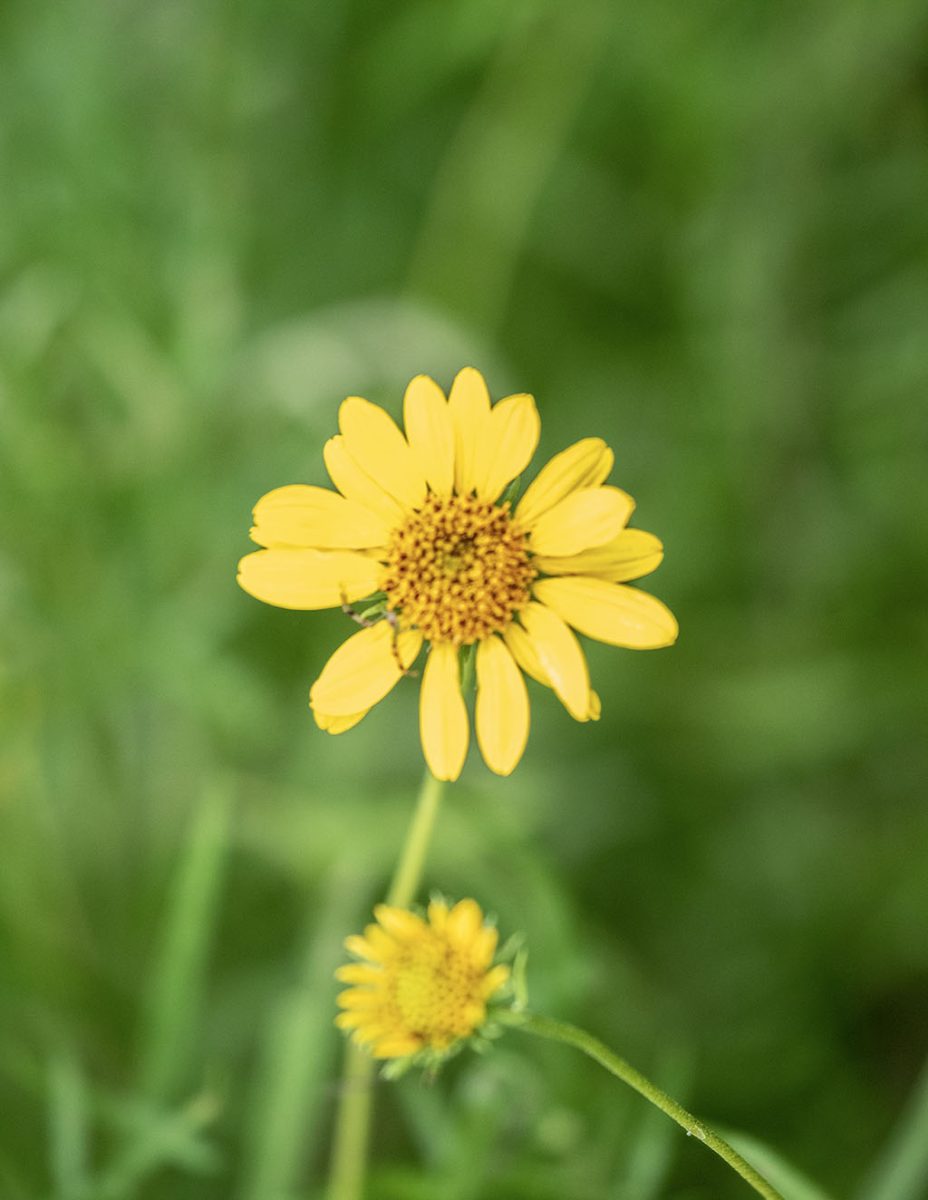
In the summer, caterpillars of border patch butterflies feast on the leaves; in fall, the flowers are thick with bees; in winter, when the flowers have faded, the copious amount of seeds attracts birds such as lesser goldfinches.
A plant closely related to sunflower goldeneye is skeleton-leaf goldeneye (Viguiera stenoloba S.F. Blake). Also a very drought-tolerant perennial, this multi-branched shrub with finely textured foliage normally grows in sun or semi-shade on dry, rocky soil. That said, it also grows in two locations in my front yard.
This relatively low-growing shrub produces small daisy-like yellow-gold flowers from June through October. During its time in bloom, skeleton-leaf goldeneye attracts myriad nectar butterflies and bees.
Beyond their value to pollinators and other insects, birds, and wildlife, sunflowers of all kinds play a significant role in the human environment. Most surprisingly, common sunflowers are used in phytoremediation, a technique by which plants clean up contaminated landscapes. They’re particularly useful in absorbing heavy metals, such as the cadmium and mercury found in mine tailings. Even more astounding, sunflowers have been used in radioactive isotopes like cesium-137 and strontium-90 from the soil after the nuclear accidents in Chernobyl and Fukushima.
One more way that sunflowers are of value to human beings? Quite simply, they make us happy.
Note: All of these sunflowers are fall bloomers, and many pollinators depend on them during that time. * They also look beautiful mixed in with other fall bloomers, such as frostweed, Turk’s cap *, and various salvias.
*Some of these plants will bloom in both summer and fall.