
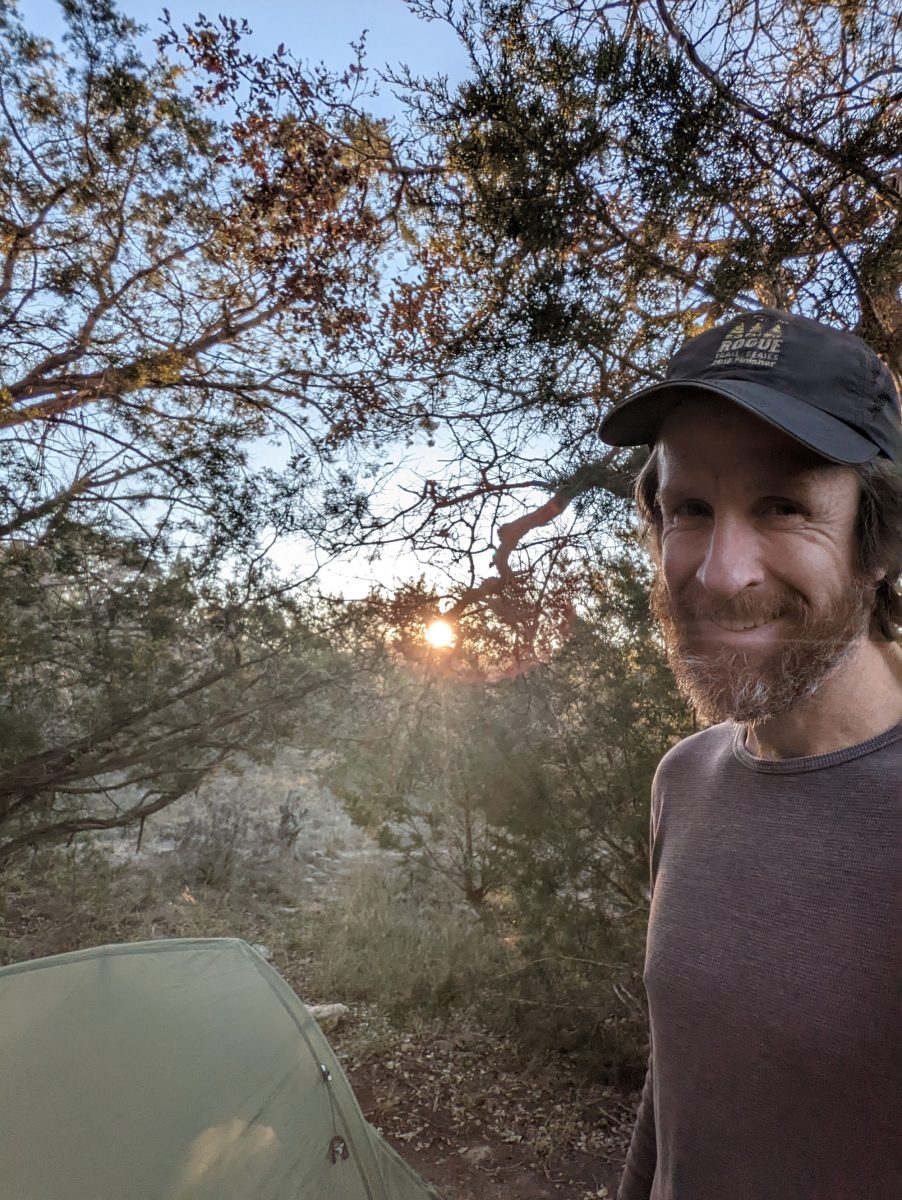
 Eric is a native Texan and philosophy professor at Texas State University. He received a BA in philosophy from Texas Lutheran University, an MA from the University of Houston, and a PhD from Cornell University. Eric regularly teaches courses in logic, bioethics, applied philosophy and philosophy of sport, and his current research interests are in epistemology (rationality, practical factors in justification for belief) and applied ethics (ethics of impact sports, ethics of vaccination). He lives in San Marcos with his wife, Amanda, and their two dogs, April and Hap, all who enjoy our trails as much as he does.
What do you see as the value of natural areas?
Natural areas give us space to explore and experience natural beauty, of course. Crucially, they also provide mental space—space for our minds to wander and disengage from our ordinary, information-driven, data-centric, algorithmic (whatever-you-wanna-call-it) lives, and to enjoy a certain kind of aesthetic experience. For some, natural areas are a kind of refuge or escape from the mundane, and they represent a wilder side of human nature. They can make us feel more alive and give us a sense of more remote possibilities for ourselves. For me, being out in nature has a way of putting things in perspective. It helps me to think a bit more creatively about my life and about the kind of life I could live.
Who or what most influenced your view of the natural world?
I had severe bouts of poison ivy rash as a kid, which impressed on me the harshness and indifference of nature. The allure of the outdoors was strong, at the same time. My dad often took my brother and me camping and hiking as kids, and he helped instill wonder, gratitude and respect for the natural environment, and all of that has remained strong. He was also a philosopher who was interested in environmental ethics, so he would sometimes bring up issues he thought were important and get me thinking more critically about our moral obligations to the environment and to future generations. He also invited prominent ethicists like Holmes Rolston III and Tom Regan to speak at Texas Lutheran University (where I went as an undergrad) and hosted them at our house, and I think these meetings influenced my thinking.
Otherwise, I think that there were certain places that had a big impact on my view of the natural world as a youth. Backpacking trips in Glacier National Park and summer vacations in the Flathead Valley in Montana were awesome. Big Bend National Park was also formative. After these experiences, there was never any question in my mind that I needed more, and that, for me, organizing life in a way that allowed for adventure and remote outdoor activities on a more-or-less regular basis was essential to flourishing.
But I think maybe the biggest influence may have been my dog Chief, an English Setter I adopted while living in Las Cruces, New Mexico in 2007. He pushed me to get out on the trails and made me discover my love for trail and mountain running. I think his exuberance sort of shook me up, roused me and awakened a desire to get moving and to really seize the opportunity to experience more of the natural world.
What attracted you to the Greenbelt Alliance?
Like many people in the local community, I enjoy our greenspaces daily and consider them vitally important, and I also understand how precious they are and the strain on our natural resources that rapid growth is causing. I wanted to be part of the community and to learn from and work with others who also care about protecting and developing our greenspaces. There are so many interesting, knowledgeable, funny and generous people in this organization, and it’s been good to be involved in some of the trail projects. I look forward to learning more and having more fun out there with these folks.
What do you most enjoy doing in support of SMGA?
Definitely trail work. I love being on the trails, especially if I’m exerting myself. I like the variety of work that we do, I like that it often requires patience, persistence, and puzzle solving, and I like that it’s sometimes quite physically demanding. (I used to like the way working with mostly a bunch of old retirees made me feel young, but now I think that ship has sailed, so to speak.)
What is your favorite trail? What do you like about it?
That’s a hard one, because I find different trails to be good for different purposes. Schulle is the most convenient for me (right across the street from where we live), and I walk the dogs there regularly. I’m also a trail runner, and I run just about all of our trails, but the one that I probably like most is Dante. I like the way that much of it forces you to focus on the present moment, and I like that it’s quite varied and has both smooth, easy sections and technical, uneven ones. Also, you can go point-to-point (from the upper entrance to the lower entrance, or vice versa) as part of a long run, and by the time you’ve run all the way through Purgatory you’re ready to hit the road where you can relax a bit and don’t have to constantly watch your feet. I also frequently run the trails at Spring Lake, and I especially like Roadrunner and Grey Fox. They’re a nice challenge and not too long, and they’re very accessible, so you can get in a good, quick workout.
What do you most enjoy when you visit the Greenbelt?
Trail running is my passion, but I also enjoy just being out there, and if I’m not running I can pay more attention to my surroundings, which is nice. I notice things that I wouldn’t notice if I were running. And, in general, I enjoy the solitude.
What recommendations would you give new users of the trail?
Watch for mountain lions, they like to surprise new users.
Seriously, I’d recommend turning your phone and your music off and just attending to your body and to your surroundings. Also remember how fortunate we are to even have these unique places! Not to be sanctimonious, but remember that there are others who want to enjoy it, and that your actions have an impact. Otherwise, just get out there!