
Editor’s Note: On June 29, the Rev. Christian Hawley began writing a weekly series on trails for the San Marcos Record. The most recent of these are available by clicking the links below. These are reprinted from the San Marcos Daily Record.
Trail Notes: “Goonies” Never Say Die – April 26, 2026
Over a decade ago, I engaged an ecotherapist whom I met at Pedernales Falls State Park for sessions that included grounding and tree-hugging. It was just a little too woo-woo for me at the time, but I do remember feeling calmer and more at peace after going barefoot in the dirt and putting my hands on some bark.
 Six years and two kids later, I began reading books like Last Child in the Woods and The Anxious Generation. Upon finishing those texts, I’ve been a lot more intentional about hitting the trails with my kids. If you’re looking to do the same in San Marcos, here are a couple of things I learned along the way:
Upper Purgatory’s ADA, crushed granite path is perfect for a running stroller. Whether you’re chasing the stroller marathon record (Two hours and thirty-one minutes!) or just looking for a way to walk with your kid in nature, this trail offers plenty of sun and flora. I loved pausing close to trees and grasses to let my kids reach out and stimulate their sense of touch with the natural world.
At some point, you’ll get tired of the same old Upper Purgatory route and want to return to single track — enter the hiking backpack. My backpacking buddies all chipped in and bought us an Osprey Poco Pack, which we’ve used for kids ages 1-5. In the world of kids’ gear, that’s equivalent to driving a car for 300,000 miles, so I highly recommend this Toyota Hilux of backpacks.
That being said, backpacking with a kid is different from carrying a tent and a Jetboil. Their dynamic, wiggly load tests your body and your footing in ways a static pack doesn’t, so stick to manageable trails like those found at Lower Purgatory. The Dante and Ripheus trails provide engaging scenery, like the Matilda Bridge to the dam overlook, while offering terrain that won’t send you sprawling the first time your toddler reaches for a leaf.
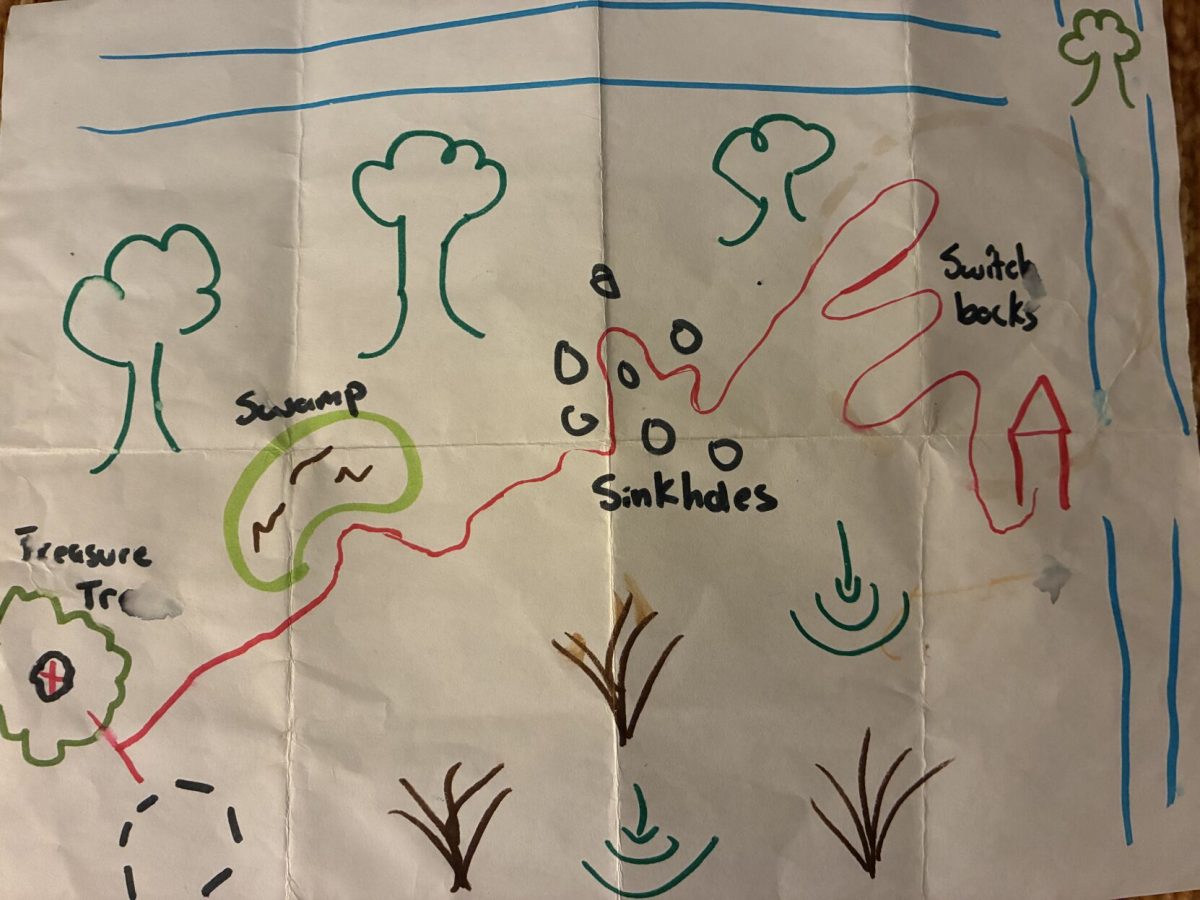
Lastly, there’s nothing more exciting than hiking with your kids for the first time on their own. I wanted to make a good first impression, so I subscribed to the ”Goonies” method of introduction, where I helped my kids discover a hand-drawn map of a local park that led them to candy stashes and buried treasures.
Virgil’s Trail from Prospect Park to the Learning Tree and Cosmic Circle provides the perfect setting for a treasure hunt. This 0.6-mile round trip offers numerous benches for snacking, informative signage on the natural sciences, and easily identifiable features like switchbacks, sinkholes and marshes, where kids can practice their map-reading and adventure skills. Hide a Crown Royal bag filled with costume jewelry and Jolly Ranchers in the crux of the Learning Tree, and you’ll have them hooked on hiking for life.
Hitting the trail with kids has been one of the most rewarding parts of parenthood, and while the verdict is still out on tree-hugging, I gotta believe tree-climbing with my kids is positively impacting their mental health and moral character. “‘Goonies’ never say die!”
Trail Notes: Trail Flix – May 3, 2026
Back in 1994, I washed dishes for Rafaelle’s Italian Restaurant, thus imbuing my sixteen-year-old person with a high bar for chicken marsala and a deep respect for food service professionals. That being said, when a friend of mine asked if I wanted to work at his family’s video store, I left my apron on the spot.
Video Magic was one of those delightful local video stores of the mid-90s, and for two blissful years, I received a pay- check for watching movies and creating inane lists: What is the best Christopher Walken movie of all time? What are the Top 5 Christmas movies involving Bruce Willis? Who was the Best Rapper/Actor Combination: 2Pac, Ice Cube, or Queen Latifah?
So when last week’s rain kept me off the trails, I harkened back to that golden era of film and asked, “ What are the best trail movies?”
Our quest begins by asking, “Should trail movies actually have to feature a trail? This kind of purist inquiry might serve us well in the genre of Christmas movies that actually have to mention the birth of Christ, but in the very niche world of trials, it eliminates almost everything but “Wild,” “A Walk in the Woods,” and “The Way.” I heartily recommend the first two books, but the movie adaptations fall well short of the prose, so if you’re looking for a Hollywood Star on the trail, forego Robert Redford and Reese Witherspoon, and enjoy Martin Sheen, who turns in a fantastic performance as a grieving father on the Camino de Santiago.
We might also ask, “Do documentaries count as movies?” This is a thorny subject, as there is much controversy around titles like “The Endless Summer” (surfing) and Warren Miller films (skiing), or more recently “Free Solo” (climbing) and Billy Yang films (trail running). To complicate things further, nowadays, some of the best content for hiking is found on YouTube with people like Homemade Wanderlust or Kyle Hates Hiking.
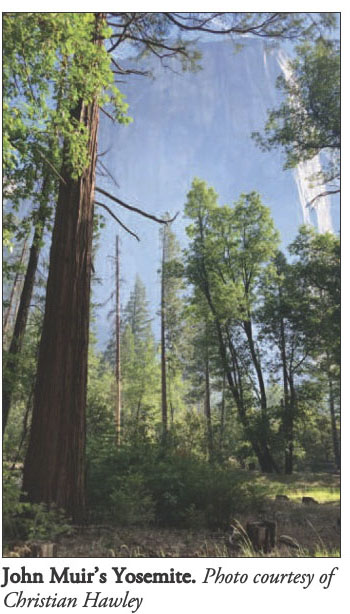
However, if you find yourself rained out and needing a trail fix, “Mile, Mile and a Half” scratches the itch with fantastic cinematography of the John Muir Trail while following a group of artist friends on their sojourn.
Finally, if we are just looking for the best movie about hitting the trail, then the answer perennially points us to “The Lord of the Rings.” Tolkien doesn’t get nearly enough credit as a nature writer, and between Bilbo’s maps, Frodo’s descriptions, and the Hobbits’ walking songs, we can’t help but want to see mountains with Gandalf! Peter Jackson’s interpretation of the texts in the breathtaking New Zealand countryside solidifies this classic as one of the best trail
flix ever.
So next time you get rained out, throw on the extended version of “The Fellowship of the Ring,” and start crafting your own walking tunes with a cuppa. As a bonus, it will also refresh you for the forthcoming “The Hunt for Gollum” film, which takes place between “The Hobbit” and “Fellowship.”
Trail Notes: Trail Moms – May 10, 2026
On this Mother’s Day, it seems meet and right to honor all the different kinds of trail moms out there: biological, cosmological, or otherwise. Over the last 47 years, I’ve been blessed to behold trail moms of all kinds who have made my trail life richer, sweeter, and fuller. So here’s a nod to all you Madres del Sendero out there.
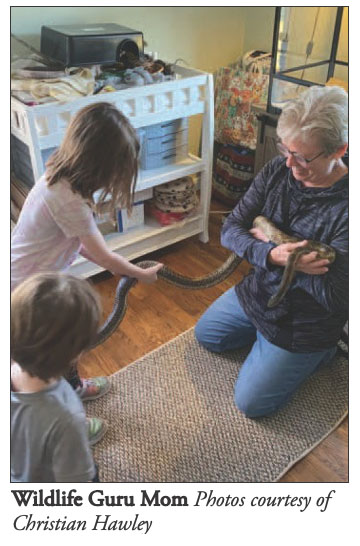
Thanks to the logistical geniuses who expertly arrange sleeping bags, coolers, and tents in the backs of station wagons, SUVs, and Honda Accords, while managing not to forget toothbrushes, stuffed animals, and sunscreen. You even managed to pack the snacks within reach of a buckled child, and you consistently and miraculously produced tweezers, bandages, and liquid IV from a hip pouch during a hike. C-17 Loadmasters have nothing on you.
Thanks to the culinary magicians who can whip up homemade GORP (Good Ole Raisins and Peanuts) tailored to each person by expanding the acronym to include craisins, mango, cashews, and butterscotch pieces. You can turn a Mountain House gut bomb into a delightful dinner with the addition of a few fresh herbs that you hauled 11 miles through two river crossings, and you never forget the smores, whether it’s roasting marsh- mallows over the log cabin campfire you built or a Jetboil flame, thus sacrificing the butane you had saved for your morning coffee.
Thanks to the leadership gurus whose Excel packing lists are the stuff of Disney legend, whose trail research makes each hike feel like a ranger-led program, and whose interactions with noisy neighbors, bureaucratic apparatchiks, and rattle- snakes demonstrate a remarkable balance of confidence, grace, and prudence.
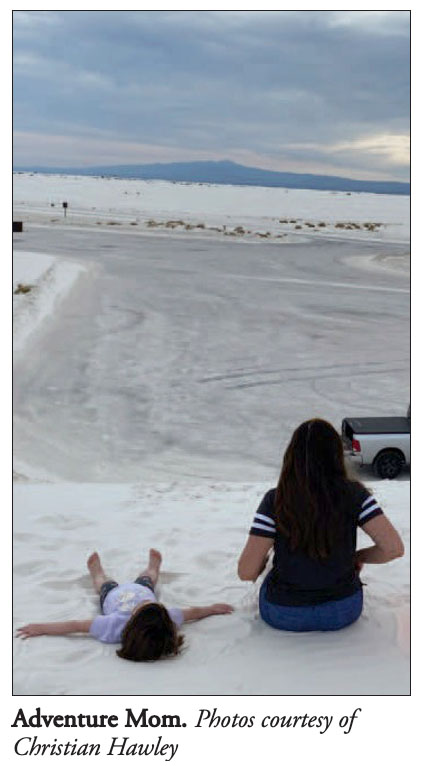
Thanks to the high adventure guides who push us a little further, luring our little legs to the scenic overlook with the promise of more M&Ms. You pull us a little higher by letting us bring school friends along on our assault of Enchanted Rock, and you take us a little deeper into the wilderness by giving of your time and money to make sure we see the Grand Canyon, Old Faithful, or the Chisos Basin.
To all you moms out there who plant the love of trails in our hearts by reading us Hatchet, Little House on the Prairie, and The Wind and the Willows—thank you. To all you moms out there who made adventure possible by giving up your weekends to be a troop leader, a mentor, or a chaperone—thank you. To all you moms out there who are there for us on the trail whenever we scrape a knee, break up with a romantic interest, or just need someone to listen—thank you. To all you moms out there who show us what a strong, confident, competent, vulnerable, humble, graceful, kind, and fun trail guide looks like, even as you try to figure it out on the fly—thank you. Thanks for being our trail mom, and we can’t wait to get back out there with you for the rest of our lives!
Trail Notes: Sissy Sticks – May 17, 2026
Once upon a time, there was an Appalachian Trail (AT) section hiker, who upon entering his mid-30s cleverly decided to use his downhill snow skiing poles to help him navigate a particularly treacherous section of the AT in North Carolina. His friends, me included, mocked him and his sissy sticks mercilessly for 110 miles. The joke was on us, though, 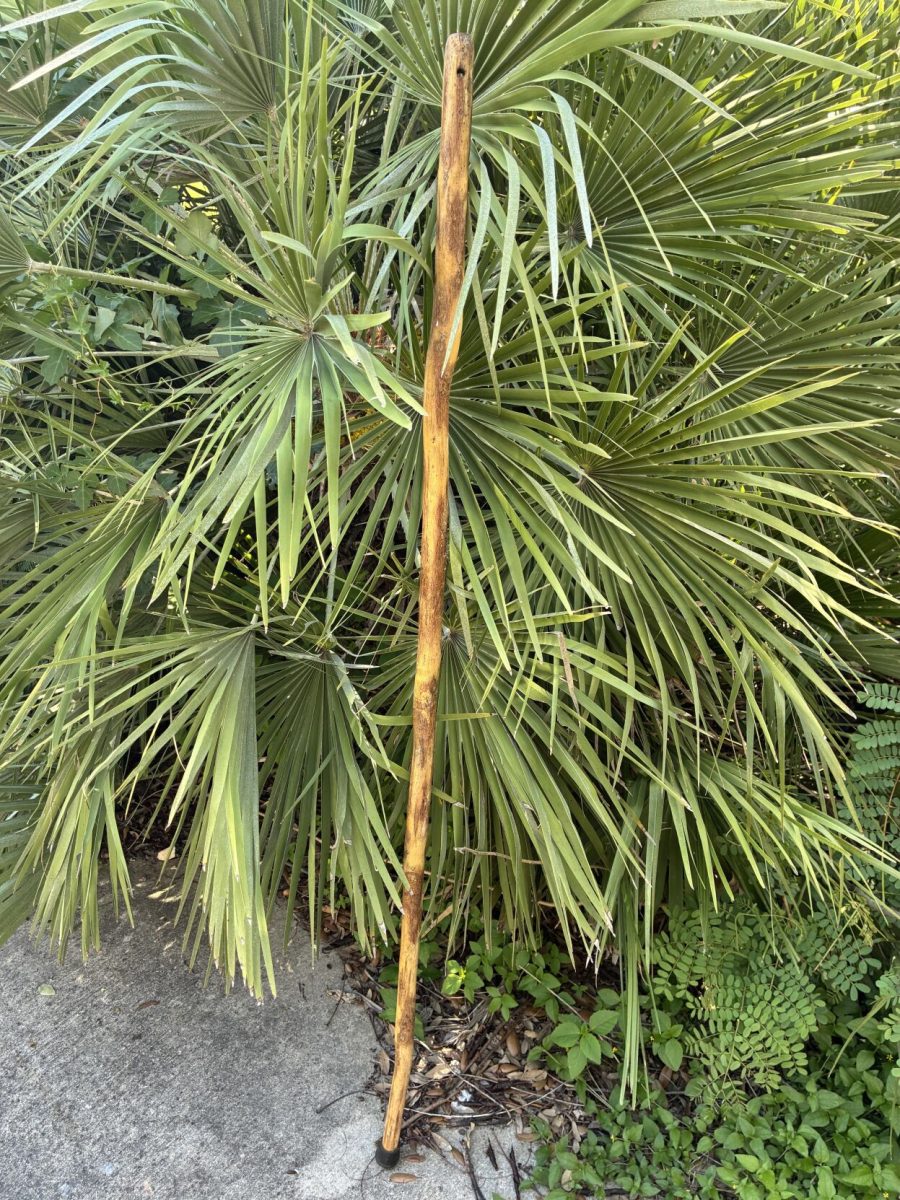 because 20 years later, hiking poles (rebranded as trekking poles) are an 80-million-dollar industry, and yours truly, after two ankle injuries, broken toes, and an arthritic knee, has spent almost $1000 dollars on sissy sticks.
So, after some hard-won experience and a few helpings of crow, I offer you these humble suggestions for hiking/trekking poles:
The Classic Hiking Stick: The traditional symbol of a sagacious trail life, this hand-turned staff is usually made of Eastern Red Cedar, although a century plant stalk makes for a lighter weight option. Perfect for prodding grandkids, leading nature hikes, or lashing demonstrations, and you can pick one up for $30-$100.
Ski Poles 2.0: My AT friend’s idea remains basically unchanged with the exception of weight, grip, and price. Where an early aughts aluminum pole weighed 10oz, a carbon fiber pole of the same size now weighs 5oz. Likewise, you can upgrade from rubber grips to an Air Cork material designed to wick moisture and dampen vibration. The original versions ran around $50 while the 2.0 versions will cost you at least $150.
Fixed length poles are worth investing in if you intend to use them every time you step on the trail. Telescoping and folding poles tend to fail at the joints or ligaments, so eliminating those parts guarantees a steady point of contact. The basic rule for sizing is your height in cm x 0.68, and Leki is the industry standard.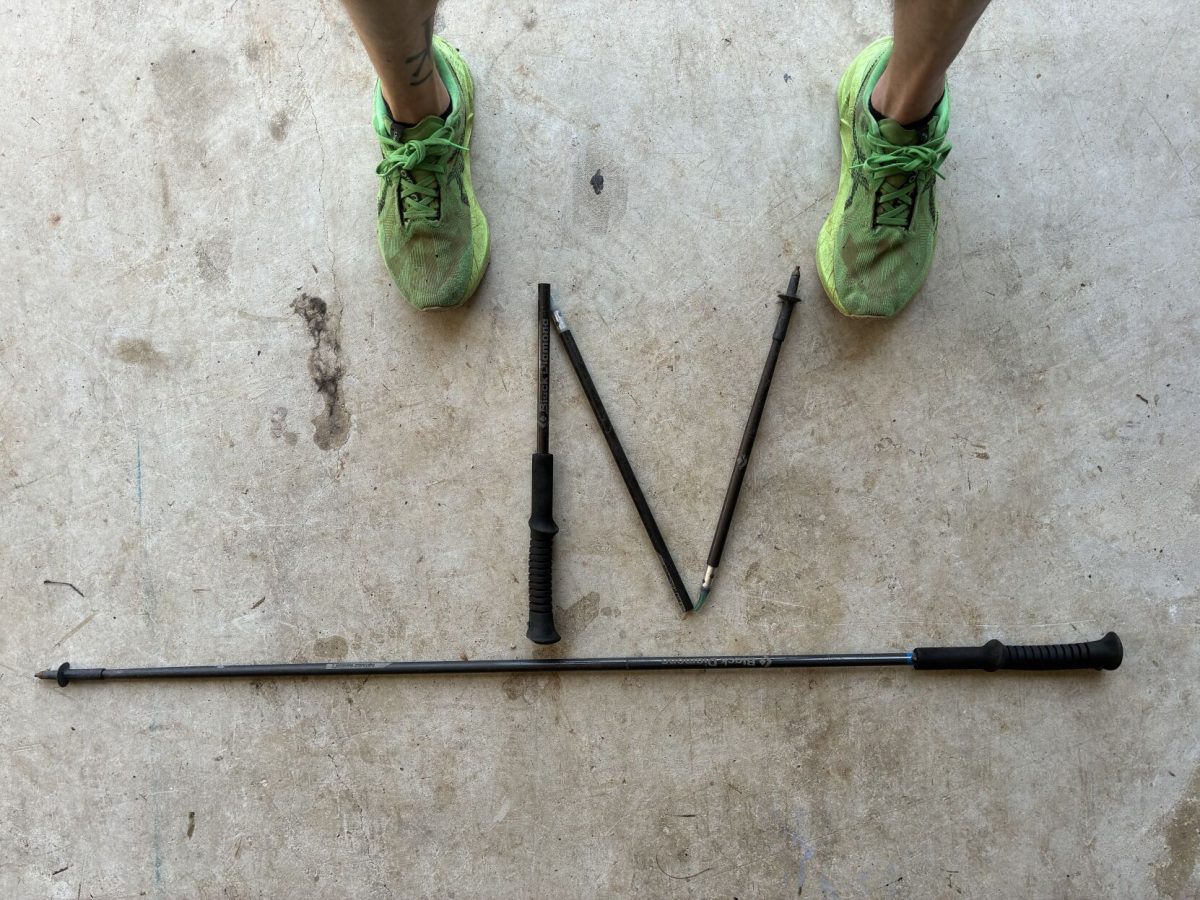
Telescoping Poles: These are the most popular kind of hiking pole, and you can find them everywhere from Walmart to REI. The height of each pole can be adjusted from 100-130cm thus making them usable for most of the population. They can also be adjusted based on terrain making them shorter for uphills and longer for downhills. As I age, the longer poles on the downhills have saved me numerous times from falling face first into a boulder!
Telescoping poles come in two types, twist or flick lock. Flick locks tend to be more reliable, but the locking mechanism can sometimes catch on your pants. Twist locks never catch, but they do tend to fail more often, collapsing catastrophically if you don’t tighten them fully, which is even worse. A good middle of the road starting point are the Cascade Mountain flick lock poles that you can pick up at Cabela’s for $65.
Folding Poles: No collapsing, no getting caught on your pants, plus you can get them in your daypack or carry on. Folding poles inhabit the best of all worlds, so you’ll pay a premium. However, if you know how to use them right, they can shave off significant trail time and body wear. Once much maligned in the trail running community, they are now a staple of races like the Ultra-Trail du Mont-Blanc (UTMB) and its qualifiers. A few years back, I attended a workshop through the veteran trail running nonprofit Band of Runners that taught good technique, and I now strap a pair to my hydration back every time my trail run ventures into double digits. I’m rather fond of Black Diamond Distance Z poles for $180, but you can spend anywhere from $80-$250 on a pair.
Texas Water Safari Part 1: Why would you do that? – May 31, 2026
The 63rd edition of the world’s toughest canoe race kicks off on Friday, June 12, from our own Meadows Center at the headwaters of the San Marcos River. For those of you who are unfamiliar, this is a 260-mile canoe race down the San Marcos and Guadalupe Rivers out into the Gulf of Mexico, arriving at Seadrift, TX, in under 100 hours. Top teams will complete the race in less than half that time, but just finishing is an incredible achievement, no matter how long it takes you!
They call the Texas Water Safari the “World’s Toughest Canoe Race” for a reason. The conditions are brutal. Texas heat and humidity combined with grueling physical exertion can lead to dehydration, cramping, nausea, heat stroke, and even hallucinations. There is no prize money, no trophies, not even a belt buckle. Finishers receive a patch… a five-inch, one-dollar patch like you’d get from a summer camp. So why in the world would you do it?
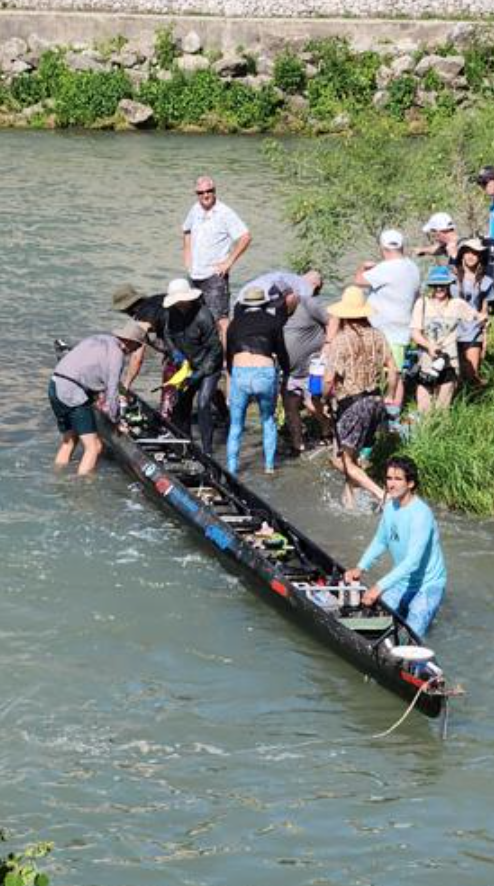
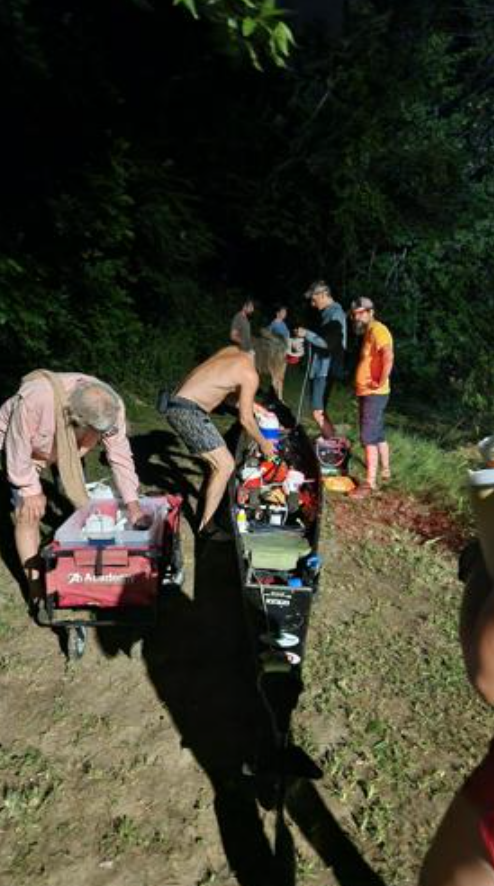
 That’s the question I asked 5-time finisher Jhet Brazil one night as we sat outside drinking — he a green tea and me a tonic and lime. Like most things ineffable, a straightforward answer eluded us, but as the lightning bugs started to appear, so did a few clear markers:
Community: In a fragmented, digital age, embodied gatherings around a singular shared passion are a rare thing, rarer still when it’s oriented toward overcoming adversity and supporting others in their journey. The safari is not just a race. For many locals and adventure enthusiasts, it is a rite of passage, and everyone who’s a part of it wants you to succeed. The community is more than just fellow racers in the boats. Every boat can have up to two team captains who are allowed to supply the racers with food, water, medical supplies, and hopefully buoy their spirits along the way. There are hundreds of people giving thousands of hours to make the race possible and get those teams down the river.
Resiliency: If you can finish the Safari, there’s not much you can’t push through in life. While it’s not the main reason for Jhet, he says it’s a popular motivation, and one I can identify with, as I do ultramarathons. Having to pick up a second shift or pull an all-nighter is nothing if you’ve paddled for 86 hours nonstop. And carrying two kids through three airports, including the psychedelic tunnel in Detroit, while subsisting on Cliff bars feels a whole lot more manageable, having survived abdominal cramps while drinking Spizz meal replacement as a teammate sings nonsense through Hallucination Alley near Victoria.
Truth: This is the most esoteric and profound reason why. All the masks we wear, and all the sideshows of this postmodern life are stripped away, leaving only you and the river. There is no place to hide. There is nothing else to do. All of reality is fully present. Paddle in, move water, paddle out. Simplicity—Movement—Truth. It’s the answer I get from big wall climbers: “The next hold is your whole life.” It’s the answer I get from Appalachian Trail thru hikers: “Today I will walk.” It’s the answer of the mystics: “Chop wood, carry water, become enlightened, chop wood, carry water.”
I’m still not sure if I understand why 191 teams signed up to do the Texas Water Safari this year, but I’m glad they did, and I love that the world’s toughest canoe race is part of the fabric of our town.
Texas Water Safari Part 2: How do you do that? – June 6, 2026
Last week, we talked with 5-time Texas Water Safari finisher, Jhet Brazil, on why people do the world’s toughest canoe race. This week, we’ll get some insights on how teams accomplish this seemingly impossible task and where we can get a glimpse of the action this year.
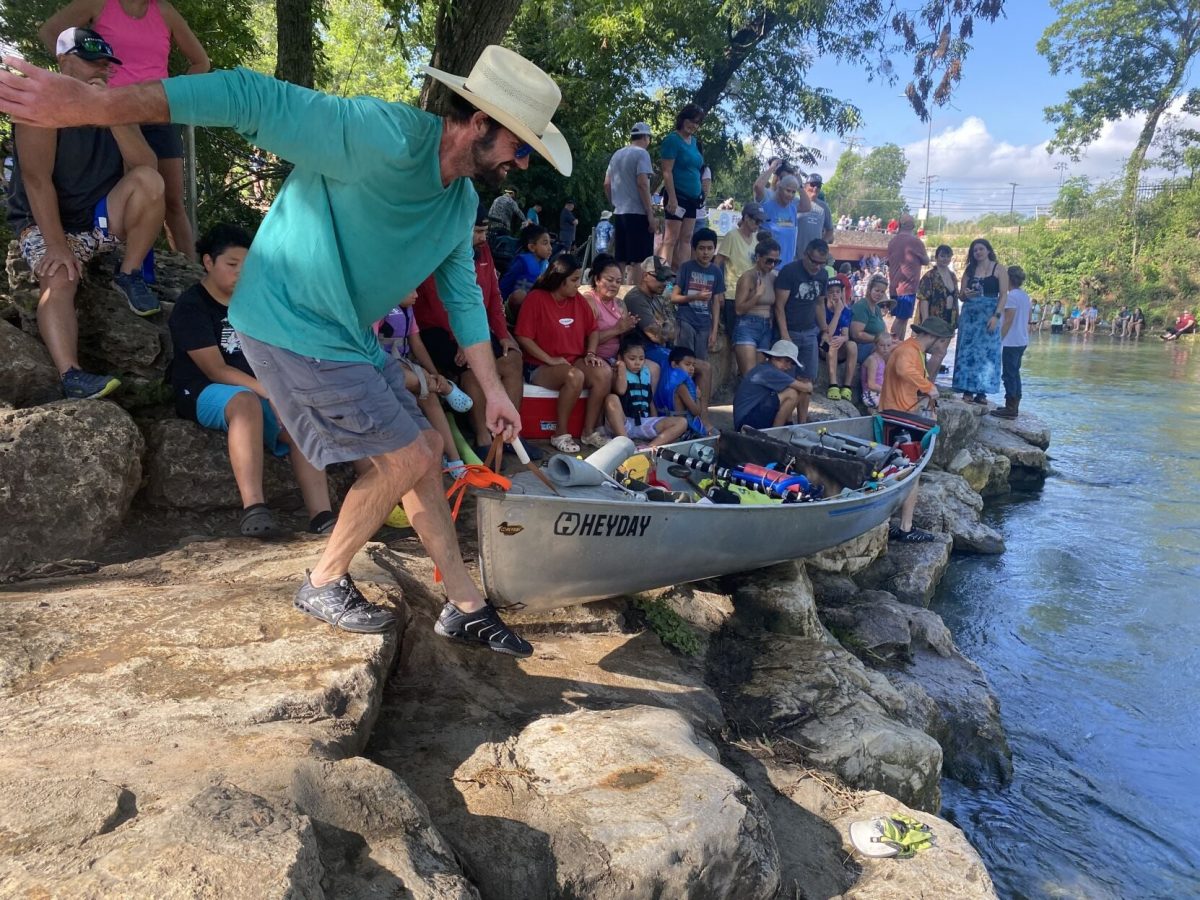 It all begins with preparation: People devote a large portion of their lives to this race. Training usually begins four months beforehand, with many teams paddling together every week. Training includes local paddles on the San Marcos River, as well as trips to Austin’s Town Lake for open-water experience, and most teams participate in buildup events, like the River Marathon and Gator Chase. All said and done, committing to the Safari totals over 100 hours, making it akin to a Master Naturalist or EMT certification.
Little changes make a big difference: When it comes to race strategies, efficiency carries the day. Jhet gave the mind boggling example of the seemingly small difference between a standard canoe paddle weighing 16oz and a carbon fiber paddle weighing 7oz. Nine ounces doesn’t seem like a lot, but multiply that by 40 strokes a minute, 60 minutes an hour, and 100 hours to finish, and by the end of the race, the poor wooden paddler will have lifted 135,000 more pounds than their carbon fiber friend!
The same math applies to nutrition breaks and water in the boat. Spizz meal replacement and a good bilge pump could be the difference between being on the water for 60 hours or 70 hours, and 10 hours is a big difference when you haven’t slept. The devil is in the details of the Safari.
Adapt and overcome: No matter how well teams prepare, there’s always something that comes up. Unexpected rainstorms, log jams, equipment failure, injuries, and the winds of San Antonio Bay. Jhet ballparked 30% of the effort comes at the end of the race. “The Cuts” are a maze of constantly changing routes in the delta, followed by waves of unpredictable height in the closing stretches of open water. No one gets out alive without a little Flex Tape, moleskin, and a few Hail Marys.
So now you know why and how people do the Texas Water Safari, it’s time to see it for yourself. The Safari starts at 0900 at the Meadows Center on Friday, June 12. Jhet recommends you catch the early viewing areas before the boats start to string out, but any of the following locations make for excellent viewing:
The Headwaters at the Meadow Center—Get an up close view of the boats and the teams as they make their last-minute adjustments, and take off on their adventures.
Rio Vista Park—Watch as teams decide to portage or shoot the rapids. A great place to see all the participants and a lot of action; comedic, tragic, inspiring, and otherwise.
Staples Dam—Still a great place to see all the teams while sleeping in a little and not fighting as many crowds. Be warned, parking can be a little tricky here.
Palmetto State Park—Get off work on Friday evening and head down to Luling to see most of the teams make the transition to their night rigging. As a popular resupply point, it’s also a chance to see the team captains and support crews spring into action.
Victoria Pumphouse Restaurant and Bar—Grab a meal or a pint anytime on Sunday, and chances are good you’ll see a team pass by. As you kick back on the terrace for Sunday brunch, keep in mind that the teams below have been paddling for over two days straight without sleep, so be kind and encouraging as they go by.
Seadrift—Welcome the teams back to terra firma and share in all of the emotions of a finish. The celebration banquet takes place after 74 hours, but teams keep coming right up to the 100-hour cutoff.
Trail Notes: Tree Notes – June 14, 2026
 Years ago, I read “The Overstory,” a Pulitzer Prize-winning novel by Richard Powers. This sweeping narrative connected people and places through trees and created a kind of taxonomy in my mind: strict rule followers—Red Oaks, flashy neon opportunists—Mesquites, super-careful late adapters—Pecans. The exercise extended to communities as well: Northern Californians—Red- woods, Deep Southerners—Magnolias, central Texans—Live Oaks.
Live Oaks are steady and sturdy like all oaks, but they don’t have the same kind
of unyielding nature as their puritan cousins, the Red Oak and White Oak. Live oaks have a laid-back feel as their meandering branches create canopies meandering branches create canopies of shade perfect for hot summer Texas days. They’re great for smoking brisket or warming a cabin during a Noreaster. The Pecan might be the state tree of Texas, but it’s the Live Oak that has shaped the Lone Star identity, which is why the majority of the Hall of Heroes at the Ladybird Johnson Wildflower Center are Live Oaks.
So what are some of the great Live Oaks of San Marcos?
Kissing Oak: Located on the west bank of the San Marcos River by the River House, this Live Oak played host to Sam Houston as he stumped for governor of Texas. As legend has it, after the event, he sought out the hospitality committee and gave them each a peck on the cheek as a thank you for their welcome. FYI— This is where Kissing Tree got its name.
Bearded Oak and Rhino Oak: Starting at the Upper Purgatory Trailhead, follow the Dante Trail to these two marked arboreal wonders. The Bearded Oak’s burls recall a Persian bust, 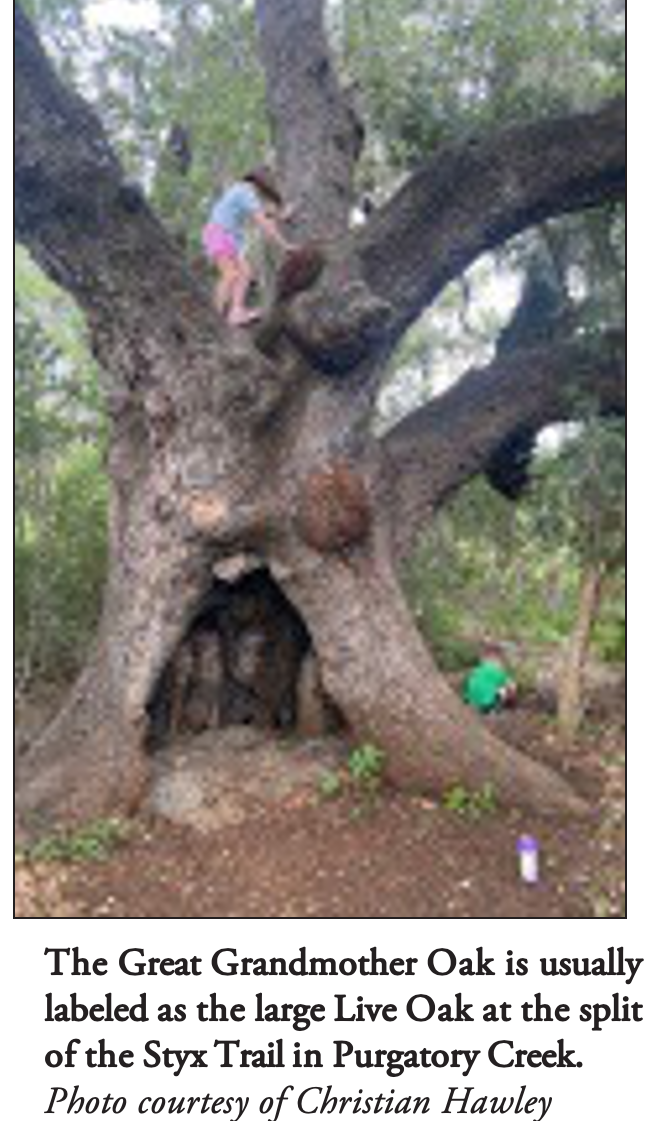 while the Rhino Oak’s long head and horn make the perfect photo op for kids.
Grandparent Oaks: I’ll occasionally get asked, “Where is the Grandmother’s Tree?” And if you look at a map, it’s usually labeled as the large Live Oak at the split of the Styx Trail in Purgatory Creek. However, what most people are really looking for is the even larger Live Oak with the cavernous trunk and full canopy of Spanish Moss. To get there, one takes the southerly route to an un- marked social trail. While both oaks are impressive, the second oak (Grandad Oak? Great Grandma Oak?) is the real treasure of the park.
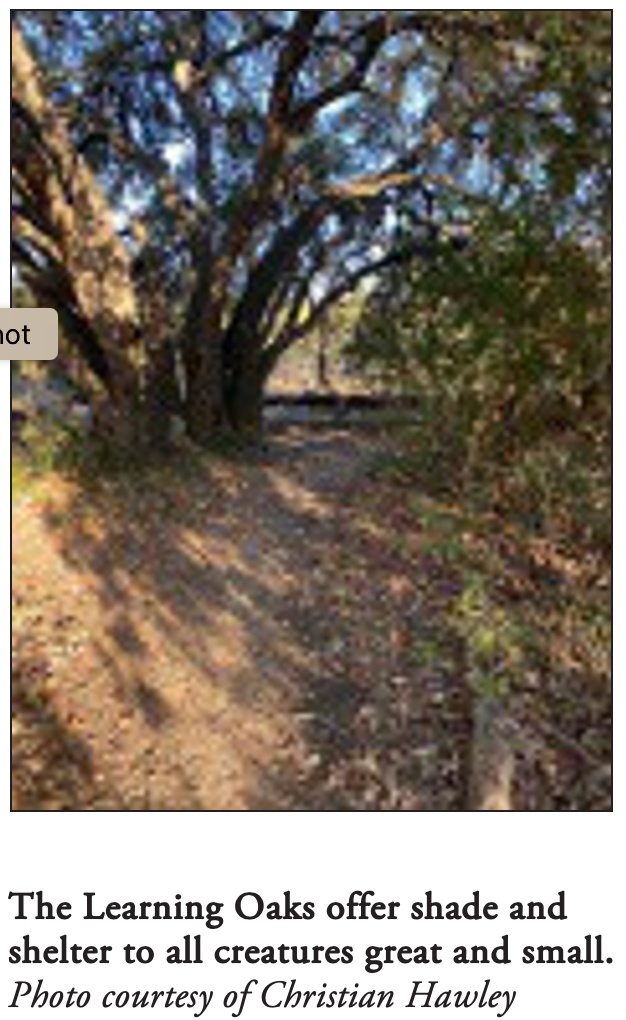
Learning Oaks: Take Virgil’s Trail from the Prospect Park Trailhead and wander past sinkholes and swamplands on your way to this delightful motte. More of a collection of Live Oaks, this centralized cluster offers shade and shelter to all creatures great and small. There are even benches to sit on as you absorb the wisdom of the ages.
Twin Oaks: Park at the end of Bishop Street and then take the Swallet Loop South into the River Recharge Natural Area. After a short stroll in, you’ll hit a shady grove dominated by a pair of Live Oaks. This naturally peaceful spot has become my go-to contemplation space since the SMGA put in a bench a few months back.