
Editor’s Note: On June 29, the Rev. Christian Hawley began writing a weekly series on trails for the San Marcos Record. The most recent of these are available by clicking the links below. These are reprinted from the San Marcos Daily Record.
Trail Notes: Trail Dads – Jun 20, 2026
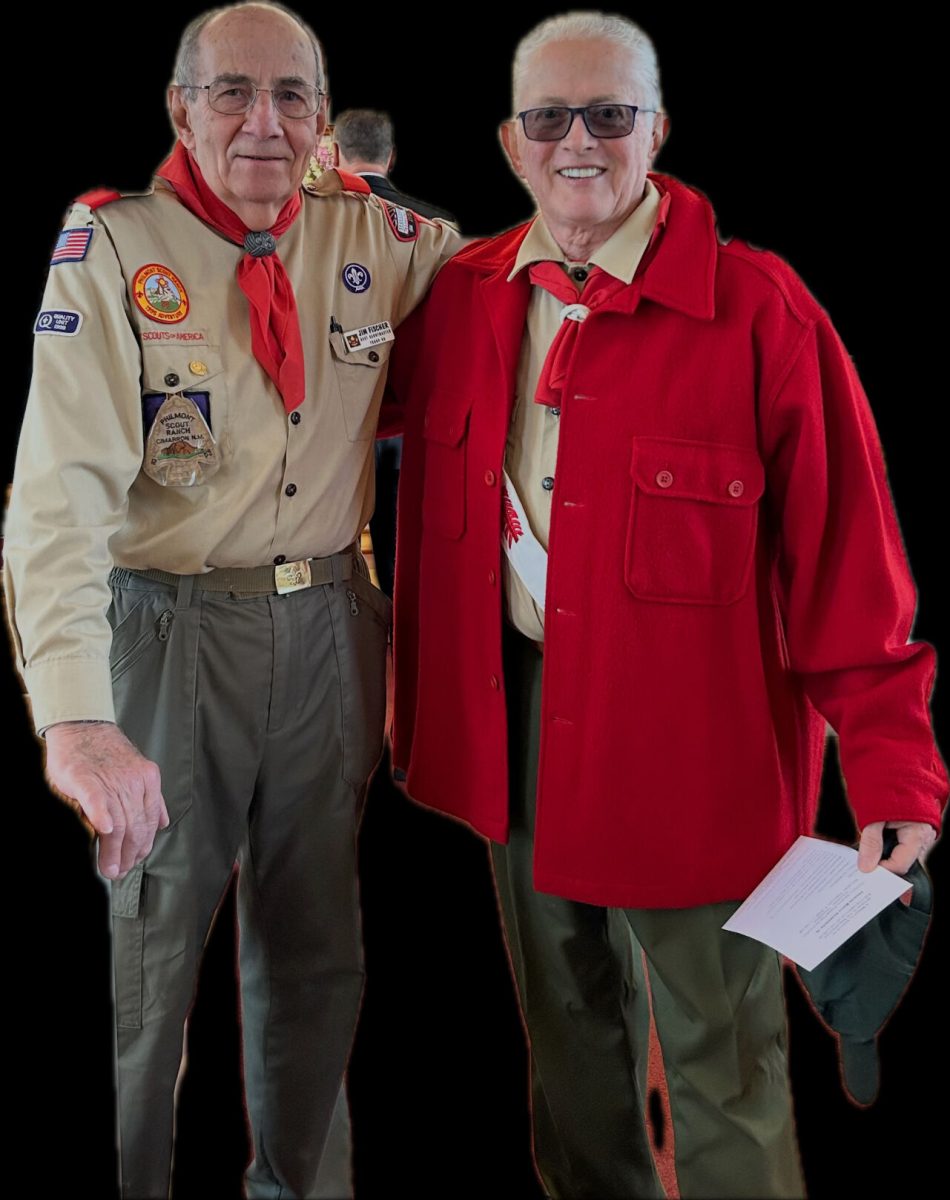 On this Fathers’ Day weekend, we give a shoutout to all those dads, biological, cosmological or otherwise, who give so much of themselves to help all kinds of kids experience all sorts of natural wonders. Dads, stepdads and foster dads, coaches, Big Brothers and scout leaders, uncles, family friends, youth group ministers and every other guy who took the time to keep us on the right path—thank you. And like we did for our Trail Moms, so we do for Trail Dads in this taxonomy. May they make you smile and appreciate your padre a little more.
The “No Former Marines” Trail Dad—His watch is still set to military time, and when he says we leave at 0700, he will absolutely leave you in the parking lot at 0702. He will also have his truck meticulously packed with everything you need for twice the duration of your trip, and he will be able to reach any tool in under a minute. He’s a stickler for fire and knife safety, but he will take hours of his time to show kids how to use both tools responsibly. These guys are usually tough on the outside but tender on the inside, so give ’em a hug on Sunday, but don’t be late.
The “Gear Head” Trail Dad—If NASA created the fabric, he’s wearing it. Tired of blowing up your air mattress? He’s got a solar-powered pump he’ll loan you. His coffee bean hand grinder and titanium pour-over kit produce coffee better than Starbucks, and his hiking poles are made from leftover stealth fighter carbon fiber. He’s also the guy who donates all his barely used gear to help those who can’t afford Patagonia, and he secretly funds the scholarship account. These guys love their toys, but they love equipping kids for the outdoors even more, so drop him a thank-you on Sunday, but you might have to send it to his satellite phone/avalanche beacon.
The “Back in My Day” Trail Dad—Wooden hiking stick—check. Starts a fire with flint and steel—check. Navigates local parks with a map and compass while muttering about declination—check. Everything takes longer with this guy, including his amazing campfire stories, which include his time as a smokejumper in Montana, a park ranger in Yellowstone and a poet in Patagonia. Chances are, his kids are older than your dad, but he keeps showing up because back in his day, after his dad died, some adult took the time to get him on the trail. No need to thank him, but on Sunday, you might look him straight in the eye and give him a slight nod of appreciation.
The “Outta My Comfort Zone” Trail Dad—Prior outdoor experience includes high scores in Oregon Trail, Deer Hunter and Pokémon Go. Has blisters on both feet within the first two miles of any hike. Depends on YouTube to set up his tent and navigates the backcountry with Google Maps. Asks a lot of questions about everything, endearing him to the kids who wanted to ask the same question but were too afraid. This dad would rather be anywhere else and would probably be dead if left on his own, but he chooses to be in the wilderness, he chooses to be vulnerable, he chooses to be uncomfortable because his kid loves the outdoors and he wants to hang out with their friends. What these dads lack in bushcraft, they make up for in heart, so come Sunday, show your thanks by not making them hit the trail.
And to the million other types of dads who cook, clean, cajole, pack, unpack, repack, lead, listen, love and spend hundreds of hours a year getting us out on the trail—thank you. Happy Father’s Day and happy trails.
Trail Notes: First Year Anniversary – June 28, 2026
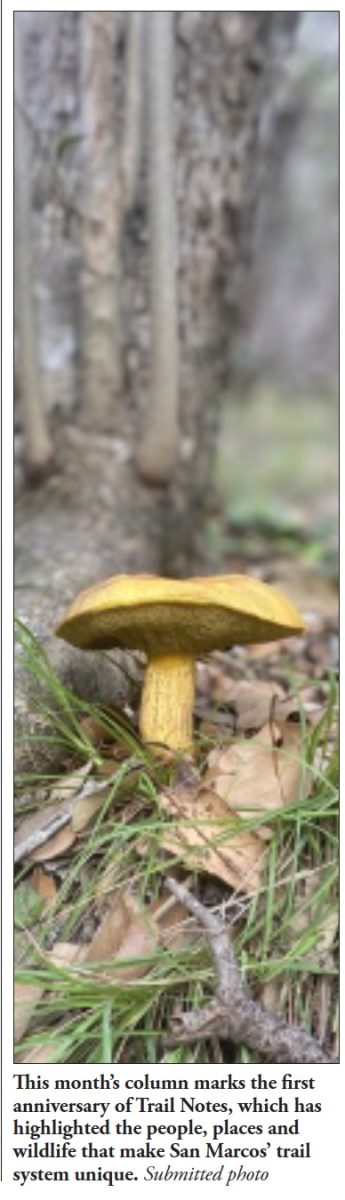
While on the Dante Trail the other morning, I ran through the web of a giant spotted Orb Weaver, which caused me to curse the advent of the Arachnids of Unusual Size season.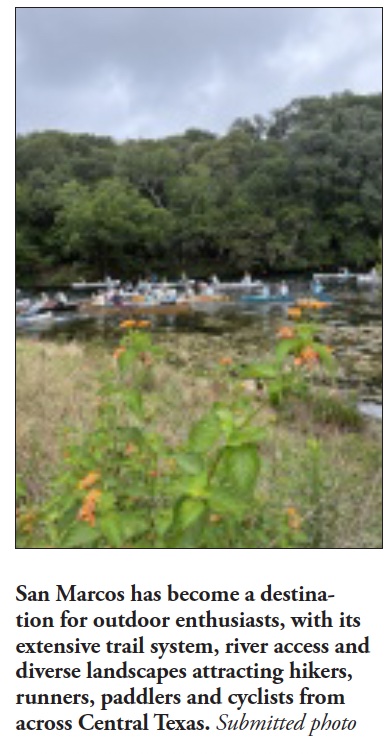
The get-it-off-me dance also reminded me that it’s been a full year of Trail Notes. And like seeing a Painted Bunting in the middle of the Swallet Trail, it’s been one delightful surprise after another. So let me take an article here to ground this column in gratitude.
Thanks to the San Marcos Record, which continues to fight the good fight or local print media and for publishing this niche little column. I have so enjoyed working with Celeste Cook, Rebekah Porter, Shannon West and John Clark over the last year. You all are great writers, editors and encouragers. I love reading your articles, and thanks for helping me with mine. Thanks to this city of San Marcos and the Greenbelt Alliance for making our town a trail destination. Next month, my old trail running club from Austin will join me again to run the Spring Lake trails, followed by a cooldown at the headwaters and breakfast at Kerbey Lane.
This is the third year I’ve invited them down, and without fail, dozens of them share their shock and amazement at the variety of terrain and experiences our town has to offer. Whether they’re trail runners, birders, mountain bikers or paddlers, they rightly recognize San Marcos as one of the best outdoor recreation hubs in Texas.
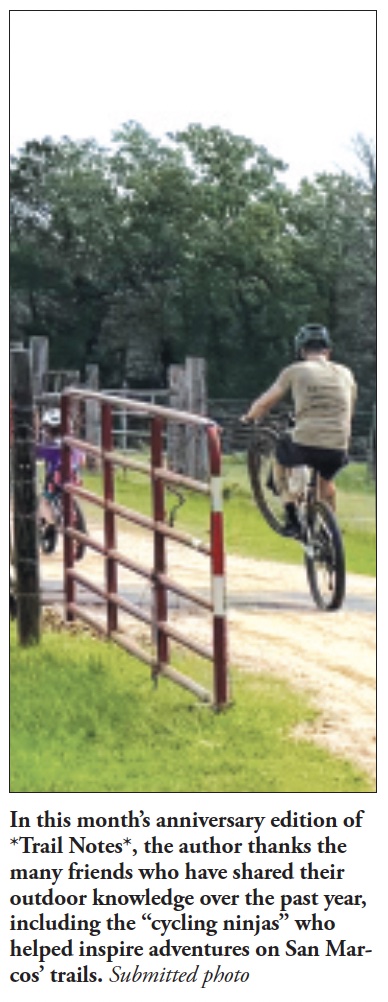
Thanks to all the friends, new and old, who have lent their voices and wisdom to this column. Greenbelt friends likethe Todfather, Cameron Herber and Susan Hanson. Neighborhood friends who turned out to be paddling gurus like Jhet and Marissa Brazil, cycling ninjas like Colin and Ellie Bromley, or amazing advocates of trail running as a path to recovery like Amy Willis. And for every person I’ve named, there are dozens of others I’ve left out, from veterans to park rangers to Dante scholars—gracias, mi amigos. And I’d be remiss if I didn’t thank my partner, my kids and my pets, who served as adventure partners, photo models and sounding boards for almost every article.
Lastly, I give thanks for this remarkable landscape we call home. When I moved from the mountains of East Tennessee, I was downright distraught over what I thought would be a downgrade of creation’s wonders. Boy, was I wrong. So thanks to the Post Oak Savannah, Blackland Prairie, San Marcos River, Edwards Aquifer, Painted Buntings, Greater Roadrunners, Bluebonnets, Agarita and, yes, even you Arachnids of Unusual Size. It’s been a great year, and I can’t wait t see what’s in store for the year to come.
Trail Notes: Trails of Our Country – July 5, 2026
As we approach our semiquincentennial, I thought it would be fun to name some trails that shaped our American identity. The paths below represent our courage and creativity, our violence and tragedy, our healing and our hope. I look forward to debating their merits with you over a dog and sarsaparilla in the weeks to come.

Trails of Freedom from Montgomery: The creativity to create a system of checks and balances representing “We the People” and oriented toward life, liberty and the pursuit of happiness is truly remarkable, let alone having the courage and will to die for such lofty ideals. Luckily, we can still appreciate the markers of these values by walking the Freedom Trail through Boston. It might seem a little hokey at first, following a red line literally painted on the ground, but it’s a wonderful 2.5 miles of history, and you can stop for chowder or a Sam Adams along the way.
Equally impressive is the skill it took to correct and reform this system of government. The humility of honest critique, the discipline of nonviolent resistance and the articulation of a new American Dream are all present from Selma to Montgomery, Alabama. Whether you hike, bike, run or drive, be sure to stop at the National Memorial for Peace and Justice and one of Martin Luther King Jr.’s favorite eateries, Chris’s Famous Hot Dogs.
Trail of Tears from Tennessee to Texas: Growing up in East Tennessee, I learned a lot about Daniel Boone and the Wilderness Road, along with Sequoyah and the Cherokee Trail of Tears. To this day, I remain impressed by the spirit of exploration and horrified by the violence of hubris. The Unicoi Turnpike Trail (2.5 miles) in Cherokee National Forest and the Mountain Goat Trail (4.5 miles) outside Sewanee University allow hikers to appreciate both the grit and the atrocity of this part of our national history.

In the process of becoming a naturalized Texan, I also learned of the end of the Indigenous way of life and the beginning of the ranching mythos, which took place in Palo Duro Canyon. Every time we descend into that natural wonder, I give thanks for the beauty of this second-largest canyon in our country. I weep for how awful we humans can be to each other as I read about the Battle of Palo Duro Canyon, and I smile at the spirit of Texas as told by an outdoor musical. There are so many great trails to hike and bike, but the Lighthouse Trail (5 miles round trip) is a must if you only visit once.
Trails of Healing from Appalachia to California: The first person to through-hike the Appalachian Trail (AT) was a World War II veteran looking to walk off the war. Much like our national parks, our National Scenic Trails are unique in that they exist not for transportation but for recreation and healing — a way for everyday people to be renewed and recharged by the movement of our bodies in nature. Most folks visit the AT while in the Gatlinburg area of Great Smoky Mountains National Park, the most visited park in the system, but if you’re looking for some truly healing solitude, try the trails around Fontana Dam at the southern end of the park.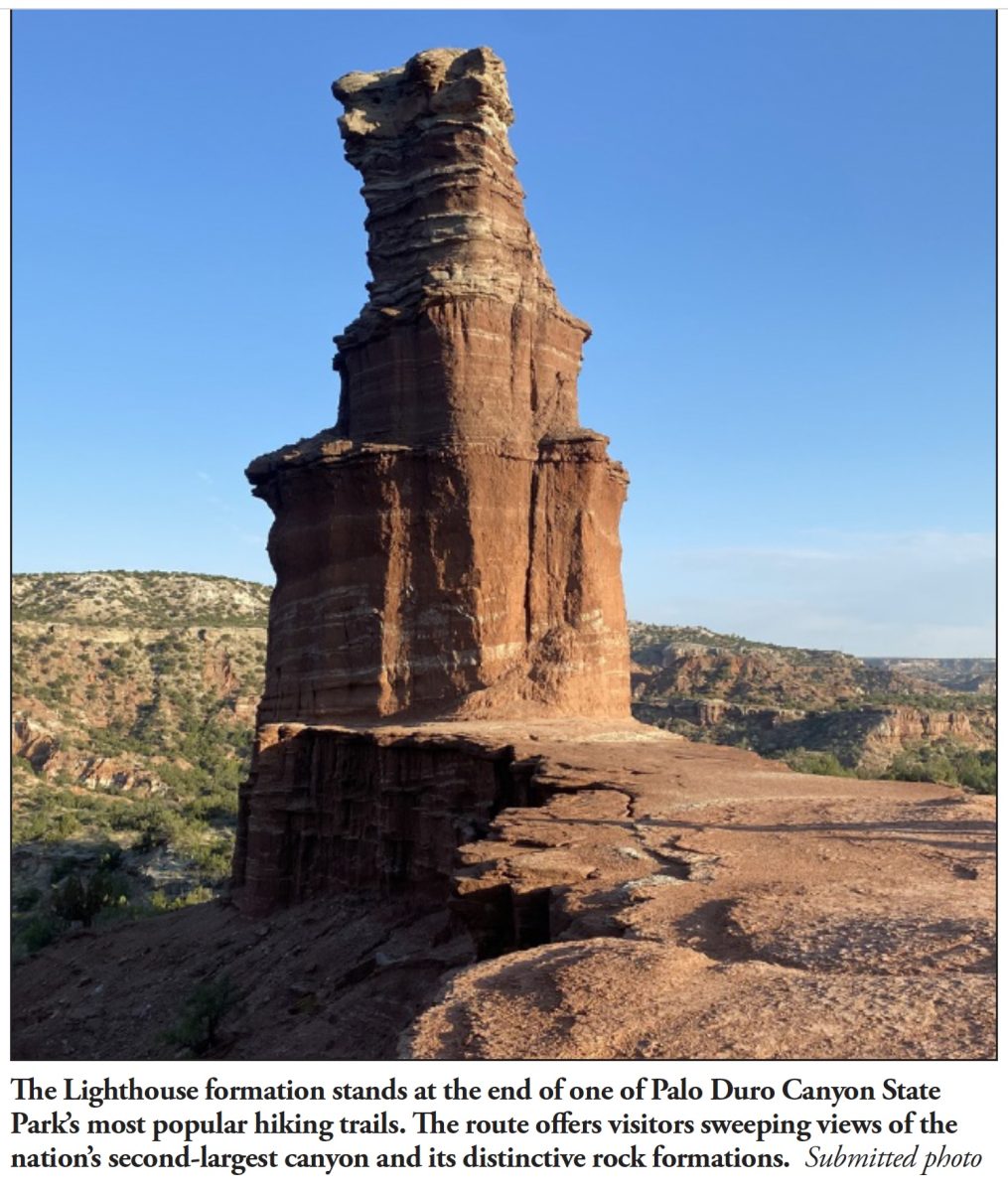
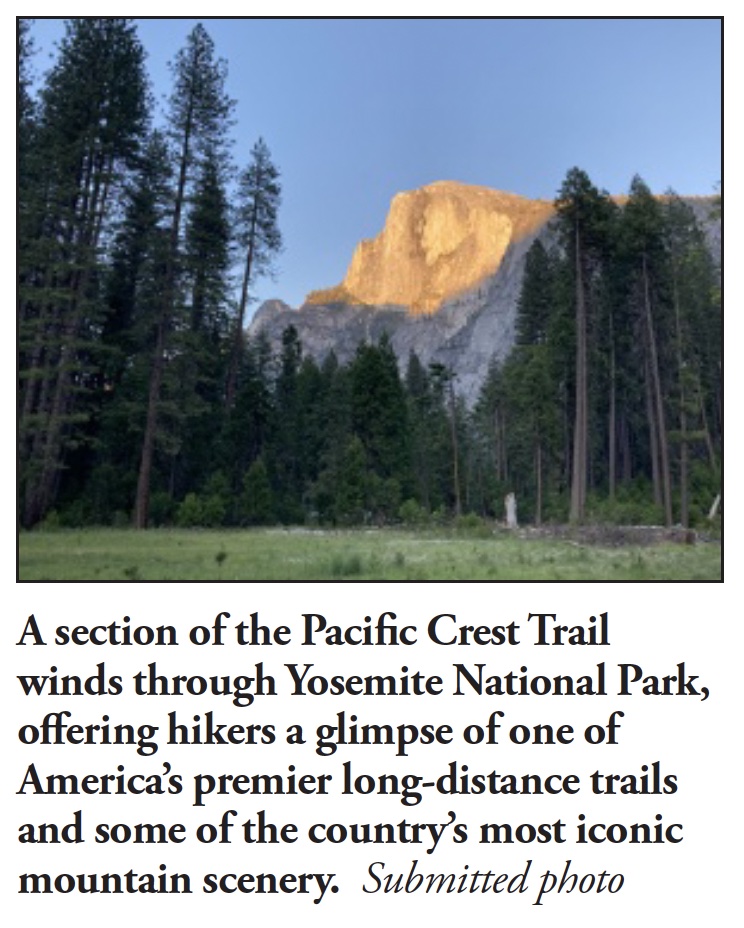
What began with the AT continues with the PCT (Pacific Crest Trail) and the CDT (Continental Divide Trail), forming the thru-hiking Triple Crown. Whether it’s the John Muir section of the PCT that runs through Yosemite or the CDT through Yellowstone, a few minutes or a few months on these trails ground our bodies, minds and souls in the spacious skies and mountain majesty of “America the Beautiful.” We’ve still got wounds to heal and work to do, but there is still a lot of hope for a country of the people, by the people, for the people … all the people.
Happy trails, America.
Trail Notes: Baked Juniper and Silence – July 12, 2026
We are now in the wee window of time between the seasons of Arachnids of Unusual Size and Horsefly Hell, where Texas hikers can find the best solitude of the season. The summer heat has baked our landscape into a kind of furnace silence, interrupted only by the puff of red dirt under our feet or the white noise of cicadas. The soaring temperatures release the sauna smell of baked juniper while imprisoning most of our hiking peers in the air conditioning. This is a great time to hike in peace (HIP).
Our cousins to the North know a similar season when freezing temperatures drive most hikers indoors while blankets of cumulative snow silence the landscape. Hiking Texas trails in July is akin to hiking Vermont trails in February. The wisdom of the North dictates that there is no such thing as bad weather, only bad equipment, and with proper clothing and planning, any season can be a good hiking season. I tend to agree, only our equipment in Texas includes hydration systems, sun protection and canopied trails.
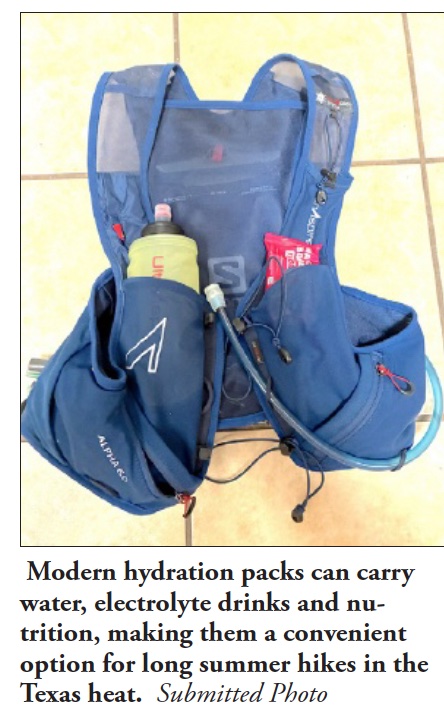
A bottle of water or a canteen attached to a web belt works for a summer hike in the Smoky Mountains but falls well short of proper hydration in Texas. Texas National Parks recommend carrying roughly four liters a day for backpackers, and so for a two-hour stroll at Purgatory Creek this time of year, we need to carry at least a liter of water. And given the amount of minerals we sweat out, water is not enough. A second liter of an electrolyte-heavy liquid like Gatorade or Liquid IV ensures we can absorb all the water we consume, and products like Skratch or Tailwind even include a caloric boost. Two liters is a lot to lug around, so if you’re going to hike comfortably this time of year, invest in a fastpack, a CamelBak, a hydration vest or even one of those snazzy fanny packs with built-in water bottle holders.
Hydration is only half the challenge of summer hiking. Protecting our skin and organs from the sun is the other half. Did you ever notice the attire of a Bedouin or a participant of the River
Safari? Their bodies are covered from head to toe in fabric. Our best defense against the sun is long sleeves, long pants and a head covering. Thanks to the fishing industry, lightweight breathable fabrics by Columbia, Magellan and Patagonia can be found in plenty, and head coverings are a great way to show some style: Stetson cowboy hat for local authenticity, Tilley Adventurer Hat for some international flair or Gilligan bucket hat for comedic relief. Just be sure it covers your ears, one of the leading locations for skin cancer and an often-ignored sunscreen location.
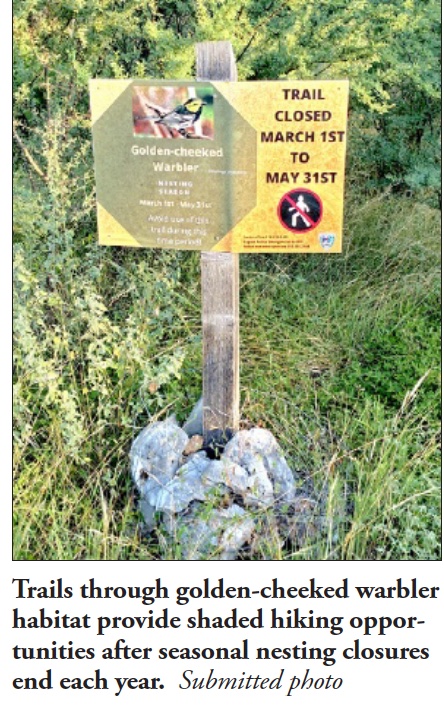
Now that you’re geared up, where do you go? This is the time of year I like to hike with the golden-cheeked warblers. Their nesting trails are closed March 1-May 31, so many folks are in the habit of not hiking them, and since they pass through the warblers’ preferred nesting location of mature Ashe junipers, you’re guaranteed solitude and that true Texas aroma of baked juniper (H-E-B should make that candle). My current favorite trails include the Grey Fox Trail at Spring Lake Natural Area and the Paraiso Trail from the Upper Purgatory Trailhead. HIP, my friends
Trail Notes: Hiking in the rain – July 19, 2026
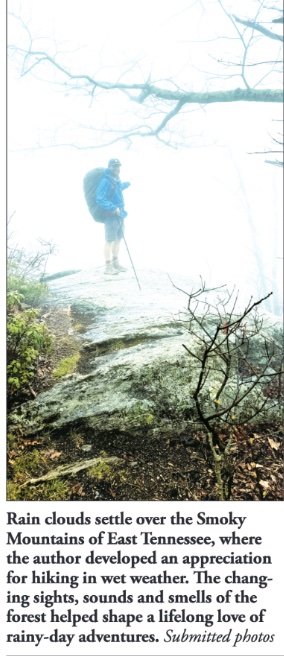
Upon showing up at a friend’s house after a hike in the rain, John Muir once said, “Don’t pity me. Pity yourselves. You stay here at home, dry and defraud- ed of all the glory I have seen. Your souls starve in the midst of abundance!”
Keeping in mind John Muir also climbed a Douglas Fir to ride out a thunderstorm, I temper my recommendation to hike in the rain with a little more reason. Having grown up in the Smoky Mountains, I experienced rain as a regular part of trail life, and on occasion, even sought it out for a different kind of adventure. By adding a little rain to the trails of East
Tennessee, pine needles effervesced, smoky clouds filled the hollers, and a gentle lullaby of rain- drops on Tulip Poplars rocked me along the trail. Hiking in the rain provided a different kind of trail joy, and the same is possible in Texas, if you know what to look out for.
While I’m more of a “Safety Fourth” kind of person, it’s paramount to say don’t go hiking during floods and stay away from low water crossings, especially if your rain gauge crests two inches. Similarly, the Greenbelt Alliance re- quests we stay off the single-track trails to keep erosion and ruts to a minimum. But once we check those two boxes, the real fun begins with what to wear.
There are two schools of thought when it comes to hiking in the rain: either try to stay as dry as possible or select gear that functions well in the rain. Some folks prefer Gore-Tex boots and Frogg Togg rain suits, while others choose trail-running sneakers and low chafe materials. For longer backpacking trips, staying as dry as possible is a great call,
but if you’re just going out for a few hours, embracing the wet is a lot more fun and a lot less mentally taxing, as you can walk through (or even jump in) muddy puddles (where are all my Peppa Pig fans at). So, where do you go to hike in the rain here in San Marcos?
Ringtail Ridge: Hiking along the boardwalk provides the driest and most accessible way to experience Texas trails in the rain. Benches dot the path, allowing hikers to sit and listen to the sonic landscape, where you can hear everything from raindrops on Live Oaks to the cacophony of Whistling Ducks.
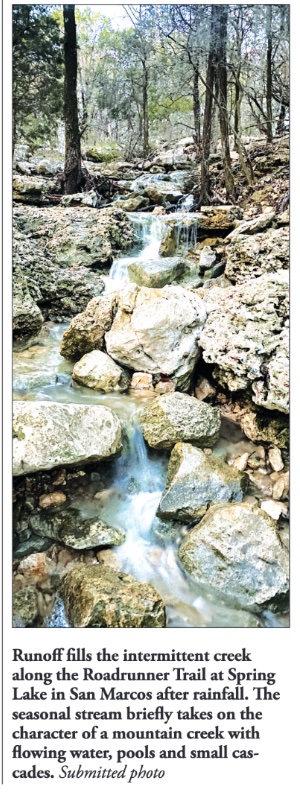
Upper Purgatory: In a gentle rain, the ADA Styx trail allows hikers to wander along a transformed path where delicate raindrops hang from Juniper branches like twinkling lights in Christmas in July. If you have kids, there’s the added bonus of the pockmarked limestone where every holy boulder becomes a Schlitterbahn for bugs full of miniature wading pools and water slides.
Spring Lake’s Road Runner Creek: I’m not actually sure this drainage has a name, but given its upper reaches run along the Roadrunner trail, it’s my best guess. It’s also the intermittent creek that most resembles a mountain stream as urban runoff gurgles down the hill to Sink Creek, creating deep pools and cascades along the way. Access can be tricky, but the LBJ trailhead is the best place to start. So as the Irish Texans say, “May the access road rise up to meet you. May the Nor’easters be always at your back, and may the summer rains fall soft upon your trails!”
Trail Notes: Finding ourselves on the trail – July 26, 2026

The butterflies in my stomach turn into dragons as the tires leave the pavement. A quarter of a mile ahead on this dirt road stands a sign that says, “Welcome to Camp Davy Crockett.” This is the first time I’ve brought a girlfriend here, and my anxiety far exceeds that of introducing her to my parents or tactless military buddies.
What would she think of my child-like enthusiasm as I recounted hijinks in Black Bear Campground or my time as a high-ropes instructor in my mid-20s, long after it was socially acceptable to serve on a camp staff? When I led her up to the overlook on the Frank Bowan Trail, would she be able to see the beauty of a TVA lake, the mysterium tremendum of the shadows in Bingham Holler, and my deep love of tulip poplars, lady slippers and all things Appalachia? I really liked this woman, but I don’t think I could marry her if she didn’t love this place, because this is where I felt most myself.
Luckily, she had shown me a glimpse of her true self, her camp self, a few months prior as we detoured from Austin to Big Bend through the friendly confines of Laity Lodge Youth Camp. She shared her passion for the headwaters of the Frio River as we swam in the waters of Blue Hole. She recounted her love of cooking and mischief as we toured the kitchen at Singing Hills, and she showed me her idea of beauty and blessing from the overlook of Circle Bluff, where the Texas Hill Country spread out below like the closing scene of a Western movie.
Camps provide kids with that all-important third space, where they are not defined by their grades at school or their pecking order among siblings at home. Camps give kids a chance to explore who they truly are and their place in the universe. A universe that includes peers from other locations and life experiences. A place that engages them with hills, hollers, holes and bluffs big enough to hold their insecurities, fears, hopes and dreams. A space where they can feel small under the night sky and large on a talent show stage. Camps are where many of us learned that trails, like life, are more about the journey and our companions than a destination or an in- dividual achievement.
Trail Notes will be taking next week off, as I’ll be in Cimarron, New Mexico, running a trail race at Philmont Scout Ranch, a camp that continues to shape me to this day. I’ll be joined by my dad, who trekked with me there in 1994, and my kids, who start their own camp memories at Rocky River Ranch and John Knox Ranch this summer. I’ll carry with me the four scout leaders whom I recently lost, and the hope that someday I’ll be that person for someone else. The race finishes over the Tooth of Time, a famous geologic feature along the old Santa Fe Trail, a ridge forever etched in my mind as the symbol of adventure, possibility and the love of trails.
I like to imagine you, readers of Trail Notes, waiting until Sunday morning to read this article on the balcony of your apartment or the patio of your home, sipping that first cup of coffee, tea or energy drink before anyone else gets up or the din of the town takes hold. I like to imagine you reading this article, reflecting on your own camp, ranch or childhood trail, and remembering who you really are and where you truly belong. Peace be with you, and happy trails
Trail Notes: Terra Oblita – August 9, 2026

Terra incognita held sway over the outdoor imagination like few other phrases. Once the siren song of explorers, cartographers used terra incognita to describe uncharted lands — the blank spaces on the maps of Claudius Ptolemy, Muhammad al-Idrisi, Amerigo Vespucci and Meriwether Lewis. As I read This Vast Enterprise, a new history of Lewis and Clark, I can’t help but feel like the explorer version of Jimmy Buffett, who once sang, “Yes, I am a pirate, 200 years too late.”
Much to my dismay, National Geographic no longer makes modern maps with the words terra incognita, and thanks to Google Earth, CalTopo, Gaia GPS and AllTrails, no hiker with a bar of Starlink service ever has to worry about being lost again. Neither do they get the joy of experiencing anything truly off the beaten.
One afternoon, our friend took us on a hike up Johnson Mesa but surprised me when she parked miles from any published trailhead on Gaia GPS or section maps. With a mix of doubt and curiosity, I followed her to a well-marked trailhead at the beginning of an easily recognizable single-track. Staring down in disbelief and joy at the lack of any trail references on my phone, we began contouring our way up the 8,000-foot mesa through forests of ponderosa pine and fields of alpine wildflowers.
My delight continued as she stopped half a mile into the hike to show my kids an “i” blaze on one of the old pines. The blaze consisted of a tree scar roughly shaped like a 12-by-4-inch rectangle topped with a 4-inch-diameter circle. This rough-and-ready marking system was clearly made by a skilled woodsman with a hatchet a long time ago.
Upon returning to the land of internet research, I discovered these “i” blazes served as the standard marking system for both the U.S. Forest Service and the Civilian Conservation Corps in the 1930s and can still be found throughout federal lands today. For obvious reasons regarding arboreal health, the practice was abandoned for paint blazes, medallions or cairns in the national parks and on the more popular trails, but in many far-flung corners of federal land, these blazes still serve to mark remarkable routes through forgotten lands. Terra oblita, Terra oblita, forgotten lands, now holds sway over my imagination. What long-lost trails still exist in real life but have been erased from new editions of maps or lost in the transfer to digital navigation? Stay tuned, rugged reader, for a little map archaeology here in Texas!