
I shouldn’t have been surprised when I learned of Wendell Berry’s death on August 31, but I was, insofar as he was someone I believed would always be around. He’s rooted that deeply in my heart and soul, and there’s no removing a presence like that.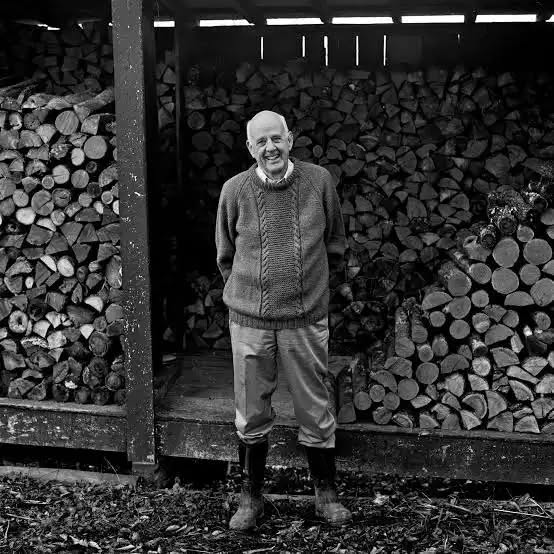
In case Wendell Berry isn’t someone you’re familiar with, let me digress a bit. A native of Kentucky, Berry was an essayist, poet, and fiction writer, as well as a farmer, cultural critic, and environmental activist. He was a hero of mine, mostly because of what he had to say about caring for the land, but also because of his emphasis on community and his decency as a human being.
I reviewed a good many of Berry’s books when I worked at the San Marcos Record years ago, and those reviews were why I was able to interview him at the Eco-Fair in Austin in January of 1994. “He doesn’t let anyone interview him who hasn’t read his work,” the person in charge of PR for the event told me. He didn’t think Berry would agree to meet with me, but to his surprise, he did—only because of the reviews I’d written about his work. Berry had been especially pleased that I’d gotten the allusion in the title of his book Watch with Me, and I’d been surprised by his surprise.
After Berry’s lecture, when we were almost alone in the auditorium, I began our conversation with a confession: “I don’t really want to interview you,” I told him. “I really just want to talk.” He was just fine with that.
“Anachronistic, naive, even preachy—Wendell Berry has been called all of these and more,” I wrote in my article covering the event. “And yet, to many of those who came to hear him at last weekend’s Eco-Fair in Austin, he is nothing less than a modern-day prophet, a voice crying in the wilderness of community disintegration, multi-national economies, and corporate greed.”
As I went on to say, no one was more surprised by the regard in which he was held than Berry himself. Ever the Kentucky farmer, he was a modest man who had no illusions about his ability to solve the problems of the world. His focus was always the local community, local knowledge, local concerns.
Berry’s essays bore out this fact, and I appreciated everything he taught me about the interwoven nature of humanity. There’s no living in isolation. There’s no health of one part of the community without the health of all.
As important as Berry’s nonfiction has been to me, it’s his poetry that worked its way into my heart. His “Manifesto: The Mad Farmer Liberation Front” reminded me to “[a]sk the questions that have no answers,” to “[b]e joyful though you have considered all the facts,” to “[p]ractice resurrection.”
Of all his poems, “The Peace of Wild Things” has probably been most important in my life. I can’t remember if I knew of the poem before this, but in 1991, I received a copy of the poem from Dr. Richard Deats, Director of Interfaith Activities for the Fellowship of Reconciliation in New York. I had met and interviewed him when he spoke at then-Southwest Texas State. In his letter, he told me he kept a copy of the poem next to his office window overlooking the Hudson River. I followed suit by taping the copy of the poem he sent me to the closet door in my office at the university, where it remained until my retirement in 2017. The poem:
When despair for the world grows in me
and I wake in the night at the least sound
in fear of what my life and my children’s lives may be,
I go and lie down where the wood drake
rests in his beauty on the water, and the great heron feeds.
I come into the peace of wild things
who do not tax their lives with forethought
of grief. I come into the presence of still water.
And I feel above me the day-blind stars
waiting with their light. For a time
I rest in the grace of the world, and am free.
Yet another poem that has meant a great deal to me is the final section of Berry’s “Three Elegiac Poems”:
III.
He goes free of the earth.
The sun of his last day sets
clear in the sweetness of his liberty.
The earth recovers from his dying,
the hallow of his life remaining
in all his death leaves.
Radiances know him. Grown lighter
than breath, he is set free
in our remembering. Grown brighter
than vision, he goes dark
into the life of the hill
that holds his peace.
He is hidden among all that is,
and cannot be lost.
Published in 1969, this three-part elegy was written in response to the final illness of Berry’s maternal grandfather, Harry Erdman Perry. I have read that portion of the poem many times over the years, read it and copied it for friends who’ve experienced loss. And now I read it with Wendell Berry in mind. He, too, is “hidden among all that is, / and cannot be lost.” I know this on a visceral level, and I find comfort in those words.
Returning to the piece I wrote about Berry in 1994, I find this at the end of the article, an excerpt from an open letter to the author from Professor Judith Weissman of Syracuse University. She said, “Everything you write is about wholeness, about our need to restore a livable ecology in our farms and our communities and our families; you are too modest to point out that you exemplify such wholeness in yourself.”
I couldn’t have said it better.
Susan Hanson
Editor, The Loop